

Scalable Inference for Growth Recommendations
Auxia is an Agentic Customer Journey Orchestration platform that delivers personalized marketing recommendations to enterprise customers. Customers integrate with Auxia by calling our API to retrieve a recommended treatment—what we call a “Decision”—across in-app surfaces, emails, or other digital experiences.
When you’re serving enterprise customers, any infrastructure faces significant scaling challenges. We presently handle a peak rate of over 6,000 requests per second (RPS), aiming for a 99th percentile prediction latency of 100ms. Each request requires selecting from approximately 1,000 potential user-facing treatments.
This post details how we built a high-performance inference infrastructure that meets those demands.
Scaling Real-Time Personalization
Three critical requirements drive our architecture decisions:
- High-volume, low-latency processing - Supporting thousands of concurrent requests with sub-100ms response times
- Real-time contextual data integration - Incorporating fresh user context and behavioral data to deliver relevant recommendations
- Multi-tenant model support - Running simultaneous inference across different models for each customer and goal combination
This combination of requirements demanded a high-performance, real-time inference system with dynamic model loading capabilities across load-balanced service instances.
Architecture: Kotlin + TensorFlow Serving Sidecar
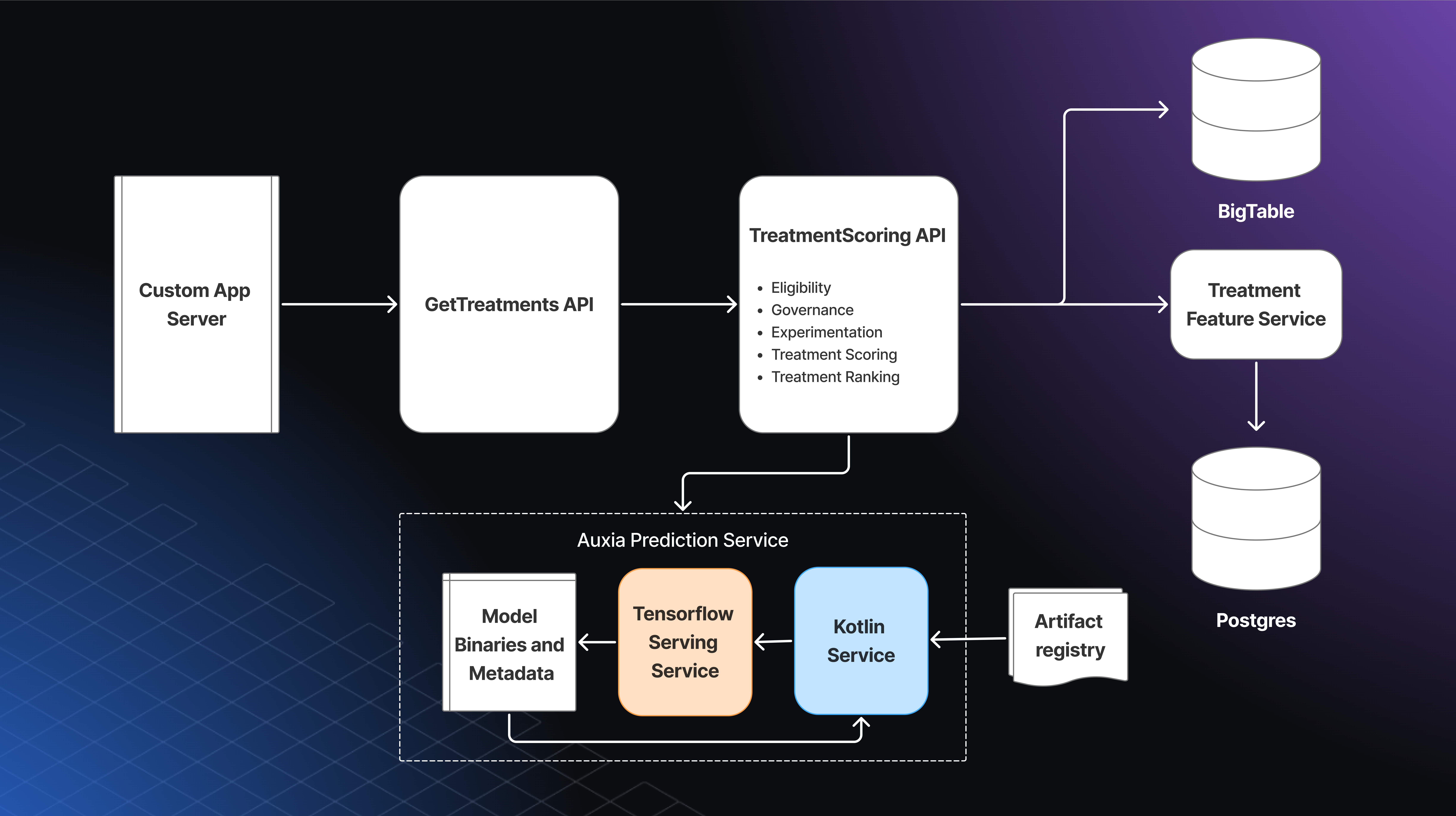
We implemented a co-located system where a Kotlin server (our control plane) sits alongside a TensorFlow Serving binary (inference engine) within each Kubernetes pod. This design gives us both high performance and maximum flexibility through clear separation of concerns:
- Kotlin server: Handles dynamic model loading, model metadata, input/output tensor transformation, and lifecycle orchestration.
- TensorFlow Serving: Efficiently loads and executes predictions on trained TensorFlow models using a high-throughput gRPC API.
This separation of concerns ensures that model logic stays isolated, while all orchestration and business logic live in Kotlin.
As a Kotlin + gRPC organization, this design leverages Kotlin's strengths—particularly coroutines for async programming—while abstracting away ML infrastructure complexity. The Kotlin layer handles:
- Infrastructure abstraction - Hiding complexities of different model types and future ML frameworks (ONNX, TorchServe, hosted services)
- Dynamic model management - Loading models from our artifact registry and managing TensorFlow Serving's ModelService
- Contract translation - Converting user and treatment features into model input tensors, and output tensors back into treatment scores
Why TensorFlow Serving?
We chose TensorFlow Serving over alternatives like TorchServe for several key benefits:
- gRPC API advantages: strongly-typed, programmatically defined interface with binary serialization that reduces message size and CPU parsing overhead, which is critical given our large feature sets.
- High performance: C++ implementation designed natively for multi-threaded usage to deliver the speed required for real-time decisioning.
- Production-ready features: built-in support for dynamic model loading and automatic inference batching.
However, Tensorflow Serving introduced several challenges that needed to be addressed by the Kotlin Server:
- Dynamic loading limitations - While technically supported, the binary is optimized for static model sets at startup
- Limited production testing - Fewer real-world deployments mean issues like incorrect CPU detection in containers
- Optimization requirements - Not all TensorFlow operations are performant, requiring careful model contract design
Inference Abstraction Layer
Our Prediction Service abstracts inference complexity into a simple, treatment-oriented API. This enables support for diverse model architectures ranging from Bandits to Tree-based Uplift models to even Deep Learning based recommender models.
Key Features
- Unified API: Single, consistent interface independent of underlying model implementation. The API contract specifies flexible input formats for user features (accepting either generic key-value pairs or a structured attribute object) and a standard key-value format for treatment features. It also defines the exact output structures that models must return, such as a single score or a list of scores per treatment.
- Dynamic Model Management: Load and serve different models on-the-fly without restarts, allowing for seamless updates and experimentation.
- Built-in Monitoring: Automatic collection of key performance metrics (like latency and error rates) for every prediction, ensuring system health and reliability.
- Developer-Friendly Tools: Model inspection capabilities and safe testing APIs for non-production validation.
Input Contract Design For Optimized Inference
TensorFlow Serving requires model inputs as a flat namespace of named tensors, essentially a flat dictionary mapping tensor names to data. Unlike TensorFlow Python’s support for complex nested structures (tuples, dictionaries, RaggedTensors), TensorFlow Serving imposes stricter requirements for serving models in production. This creates challenges when representing structured user and treatment features at scale.
Performance Optimization Journey
We experimented with several input designs to find the most efficient approach:
- Initial approach: One tensor per feature with feature names as keys. Simple to implement but highly inefficient; tens of thousands of tensors per request created significant serialization and name resolution overhead.
- tf.Example approach: Encoding features into TensorFlow's standard serialized format. Failed to improve latency due to costly proto parsing during inference.
- Final optimized design: Collapsed same-type features into single-typed tensors, distinguished by index positions. This approach minimized tensor count while aligning with TensorFlow's internal feature resolution.
Implementation Details
- User features are packed into typed tensors like [None, 4] for numerical features, where indices correspond to specific attributes (signup age, LTV, etc.).
- Treatment features use [None, None, N] format supporting multiple treatments per user, with an accompanying treatment_counts tensor indicating treatment boundaries per user.
- GPU optimization leverages TensorFlow Serving's auto-batching. The treatment_counts tensor handles padding removal and correct treatment boundary reconstruction.
- Metadata coordination ensures alignment between training and serving through embedded metadata files that map tensor indices to human-readable feature names.
This optimized design enables us to serve large-scale real-time inference at p99 latency under 100ms while scoring up to 1,000 treatments per request at 6,000 QPS.
Serving Model Validation Framework
Every trained model must be compatible with our Prediction Service API. We built a comprehensive local testing framework with three stages:
Environment Setup
Complete, self-contained production stack instance including Kotlin Prediction Service and TensorFlow Serving process. Programmatically launched locally by fixtures to test against actual service binaries, not mocks.
Test Orchestration
Managed by pytest and helper classes that handle model artifact placement and provide high-level client abstractions. Test authors work with pandas DataFrames while the framework handles serialization, gRPC requests, and result parsing.
Test Execution
Validates model compatibility through a file-based testing endpoint. The service reads model and feature files, performs inference, and writes scores to output files for validation. This workflow confirms that trained models can be loaded, served, and queried correctly before production deployment.
Dynamic Model Loading
Auxia’s dynamic model‐loading system allows customer requests to specify models by name and digest, then transparently fetches, validates, and serves those models without inference server restarts.
Model Distribution
Models are published as OCI images in Google Cloud Artifact Registry. Each image contains a TensorFlow SavedModel at /data/tensorflow_serving_model/model and a metadata.json file describing input/output contracts. This enables ML Engineers and Data Scientists to push new versions frequently with floating labels (latest, canary) for rapid production deployment.
Runtime Architecture
Incoming gRPC Predict requests route through a ModelRegistry that dispatches to appropriate ModelLoaders based on model name prefixes. For container-based TensorFlow models:
- DockerModelLoader resolves fully qualified image names, handles live and canary tags, fetches image manifests, and produces lightweight specs pointing to chosen digests
- TensorflowModelLoader stages models on disk and orchestrates two coordinated state machines maintaining synchronization between our internal view and TensorFlow Serving's configuration
State Machine Management
ModelStateMachine manages individual model lifecycles:
- NEW → DOWNLOADED (files staged locally)
- DOWNLOADED → LOADED (reload-config sent to TensorFlow Serving)
- LOADED → AVAILABLE (GetModelStatus confirms serving readiness)
- Idle models automatically unloaded and deleted after configurable duration
- Read/write mutex guards with backoff timers for transient failure handling
TFServingStateMachine aggregates all loaded models into a single ModelServerConfig, pushing updates via ReloadConfigRequest API. This prevents race conditions between concurrent operations and handles known TensorFlow Serving bugs where unknown-status errors indicate successful reloads.
Both state machines run in Kotlin coroutines on dedicated dispatchers, ensuring asynchronous operation without blocking server I/O threads.
Canary deployments are first‐class features of our architecture. Models tagged with _canary trigger the Docker loader to read ModelCanaryConfig protobuf from image labels, specifying traffic fraction and monitoring parameters.
The system probabilistically routes specified percentages of requests to new versions while maintaining traffic to live versions. Canary models are pre-warmed to minimize latency spikes, and automated monitoring of latency, error rates, and output distributions drives promotion or rollback decisions.
This dynamic loading system provides robust, zero-downtime model lifecycle management enabling rapid experimentation and safe production rollouts.
Latency and Performance Improvement
- Our optimizations delivered significant latency improvements across the inference pipeline:
- Note: Latency scale is logarithmic. Figures based on load-tested results under heavy serving pod load. Production figures can be 10x better at 99th percentile. No 99% latency data available for Python Pandas baseline.
- The combination of optimized input contracts, efficient batching, and dynamic model management allows us to meet our ambitious performance targets while maintaining the flexibility needed for rapid ML experimentation and deployment.


Auxia’s Analyst Agent: Understanding the “Why” Behind AI Decisions
Today, I’m incredibly excited to share something that’s been a long time in the making: we’re launching a major upgrade to our Analyst Agent, a product that’s going to change the way marketing teams run analyses on their existing marketing initiatives.
If you’ve ever waited days—or weeks—for a data science team to answer questions like “What are the characteristics of our highest performing customers?” or, “Which email variations resonated most with customers from a specific acquisition channel?”, you know how frustrating it can be. We built the Analyst Agent to solve that exact problem. And now, it’s better, faster, and smarter than ever.
Ask a Question, Get the Why—Instantly
With the new Analyst Agent, you don’t need to be technical to understand what’s driving your performance with Auxia. Just ask a question in plain English:
- “Which cohort responded best to the onboarding email we refreshed last week?”
- “Did our upsell nudges in the app outperform control for high-income users?”
- “What are the characteristics of creative that perform well? What performs poorly?”
Our AI Decision Agent is already making hundreds of millions of decisions every day—deciding the optimal action, content, incentive, surface, and frequency to drive our customers’ objectives. Now, with Analyst Agent, your team can actually understand why those decisions worked—and how to make them even better.
Saying Goodbye to the “Black Box”
Let’s be real: marketers have been stuck in the dark for too long. AI systems can often perform better than rules-based logic, but without visibility into what’s driving results, teams are left guessing. That’s the “black box” problem—and we’re breaking it wide open.
So what’s new with our latest release? Here are the three big breakthroughs we’ve delivered:
- Move As Fast As Your Ideas: Weeks of analyst work? Gone. With a new, chat-based interface, the Analyst Agent delivers answers at the speed your campaigns move. That means faster experiments, faster learnings, and faster revenue impact.
- Intelligence Without the Overhead: The Analyst Agent is built for the way marketers think and doesn’t require a technical background. Simply ask a question—about customer cohorts, regions, or content variants—and the agent adapts to surface what matters most. It’s powerful enough to handle complex questions, but intuitive enough for anyone to use.
- Enterprise-Grade Security and Reliability by Design: Connect securely to your existing data with the same compliance, privacy, and performance standards you expect from any mission-critical tool. Auxia does not share data across companies, ensuring your critical insights and data remain private and protected by default.
From Insight to Advantage: How Analyst Agent Compounds Value
Unlike traditional analytics tools, the Analyst Agent is designed to uncover deeper, campaign-level insights. It’s not just reading data—it’s learning from it.
What makes the Analyst Agent unique is that it connects directly to Auxia’s proprietary treatment framework and decisioning data. This means the agent operates on top of proprietary data and intelligence that already understands who saw what, when, and why–unlocking real-time insights that a generic BI tool can’t replicate.
Because every Auxia-powered experience is already structured for measurement from the start, the Analyst Agent can automatically isolate causal effects, compare treatment variants, and synthesize learnings without manual setup. The result: precise, actionable insight—without SQL, delays, ambiguity, or guesswork.
The best part? The more you use it, the better it gets. Every interaction with the Analyst agent adds to a growing body of institutional knowledge for your organization. It logs your questions, tests, and outcomes into a structured knowledge base, remembering prior decisions and identifying crucial patterns. Over time, it starts to surface the right insights before you even ask—reducing repetitive work, accelerating learning, and making your team smarter with every session.
With the Analyst Agent, growth intelligence doesn’t just scale—it compounds.
Using the Analyst Agent to Drive Smarter Decisions
The Analyst Agent isn’t just a tool you query—it’s a partner in your thinking.
From the moment you engage, it guides you through a collaborative exploration process designed to unlock insight, even when you're not sure what to ask. It can:
- Propose instructions for exploration based on the analyses it can run
- Ask clarifying questions to refine the scope of your inquiry
- Adapt in real time based on your responses, feedback, and hypotheses
Whether you're pressure-testing a campaign strategy or chasing an unexpected spike in conversions, the agent helps frame the right questions and drives you toward the “why”.
What’s Next
The enhanced Analyst Agent is rolling out to select customers now, and we’ll be expanding access throughout the summer. If you're already using our AI Decision Agent, you're going to love what this unlocks. And if you're new to Auxia, this is the perfect time to explore what Agentic Customer Journey Orchestration can really do for your organization.
If you’re curious to see it in action, fill out this form for a demo.

Auxia Enters Japan to Support the Next Era of Customer Experiences
Today, we’re excited to announce Auxia’s official launch in Japan as we expand the reach of our Agentic Journey Orchestration Platform. Across countless conversations with marketing and product teams, we’ve consistently heard a similar theme: teams want to deliver more relevant, personalized experiences—but face real constraints around time, resources, and complexity.
We believe AI can shift this paradigm. Auxia enables teams to move faster, experiment more intelligently, and scale personalization in ways that were previously out of reach. With this launch, we’re thrilled to bring our platform to one of the most sophisticated and quality-driven markets in the world—and to support Japanese organizations in shaping the next generation of customer experiences.
Why Japan?
Japan is globally recognized for its exceptional standards in quality, precision, and customer experience—values that deeply resonate with us at Auxia. From the beginning, Japan has been a key market in our global vision. Today, we’re proud to introduce our Agentic Journey Orchestration Platform more broadly to the region. We've already partnered with several forward-looking enterprises, and we see tremendous potential to support Japanese companies as they navigate the global shift toward more intelligent, AI-powered customer engagement.
Local Team and Leadership
Leading the Auxia’s Japanese operations is Hirotaka Yoshitsugu, who has been appointed as CEO of Auxia Japan K.K.
Yoshitsugu brings over 20 years of experience in building platform ecosystems. After managing i-mode partnerships at NTT Docomo, he helped launch the Tokyo office of AdMob. Following Google’s acquisition of AdMob, he joined the U.S. headquarters, where he built the international expansion of Google Play from the ground up. Later, he returned to Japan to lead Google Play’s partner business locally.
His deep roots in Japan’s tech industry make him an essential leader for Auxia’s expansion in the region.
Bringing Agentic Journey Orchestration to Japan
Today, Auxia powers customer experiences across a wide range of industries—including finance, retail, media & entertainment, and telecommunications. But our platform offers far more than simple automation.
At its core, Auxia helps teams reimagine what’s possible by removing the barriers that traditionally slow personalization down. Our platform:
- Activates all your first-party data, eliminating the need for months of engineering work by automatically handling the infrastructure required to deploy machine learning models into production.
- Enables rapid experimentation at scale—testing hundreds of hypotheses in parallel without relying on rigid, rules-based journeys or time-consuming manual A/B tests.
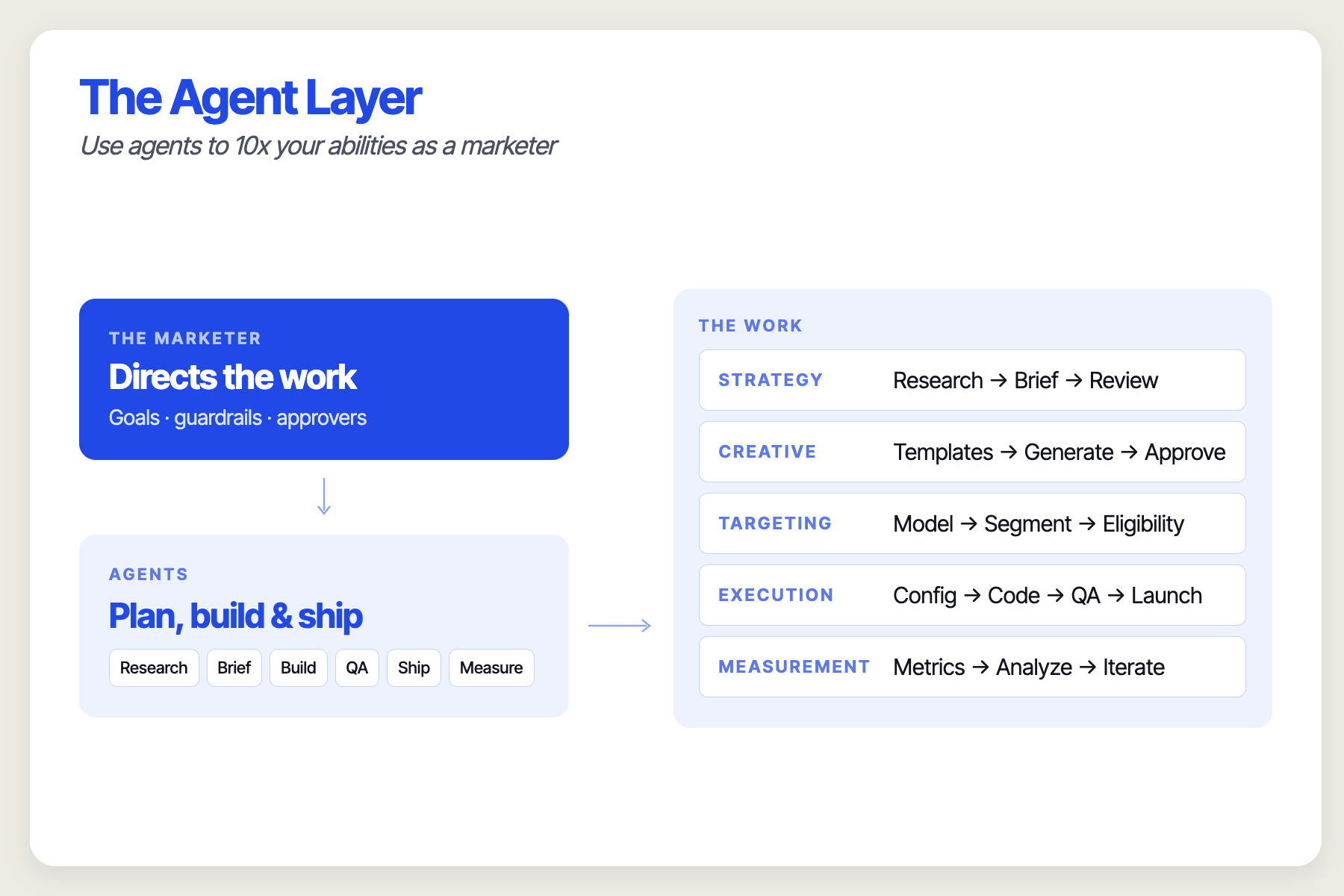
- Delivers the right message, action, offer, timing, and frequency for each individual customer. Just define your goal, set the guardrails, and Auxia intelligently handles the rest.
- Continuously adapts and optimizes in real time, learning from every interaction to improve outcomes—without manual tuning.
- Surfaces granular behavioral insights, highlighting subtle differences across customer segments that are difficult to identify with traditional tools.
And perhaps most importantly, Auxia puts all of this power directly in the hands of marketers—no technical expertise required.
What's Next
In the coming months, we’ll be establishing a physical presence in Japan and deepening our partnerships across a wide range of industries. As part of this commitment, we’re actively hiring for key roles in customer success, solutions engineering, research, and more.
Our priority is to build a team rooted in local expertise—professionals who deeply understand the unique dynamics of the Japanese market and share our ambition to transform how customer experiences are designed and delivered. By investing in talent, infrastructure, and long-term collaboration, we’re laying the foundation to support our customers in Japan with the precision, responsiveness, and care they deserve.
Looking Ahead: Building for Long-Term Impact in Japan
To all enterprises and organizations in Japan looking to harness AI to elevate your customer journeys — we invite you to join us in building the next layer of intelligent infrastructure.
We’re excited to collaborate with you and help shape the future of your business, together.

Common Use Cases of Agentic Journey Orchestration
The rise of Agentic Journey Orchestration and AI-driven decisioning is transforming the way marketing and product teams work — not just incrementally, but fundamentally. These systems go far beyond traditional automation by embedding intelligence directly into user journeys, enabling real-time decision-making and hyper-personalized experiences at scale.
Rather than relying on static funnels or rule-based triggers, marketing teams can now deploy adaptive agents that continuously learn from customer behavior, optimizing touchpoints dynamically to increase a number of objectives, like engagement and conversion. Product teams, meanwhile, are using agentic orchestration to test and evolve features in real time, unlocking faster iteration cycles and more responsive user experiences.
These capabilities aren't theoretical. They’re driving measurable gains in campaign performance, customer retention, and product adoption across industries. By integrating decision intelligence and journey orchestration into their core processes, leading teams are shifting from reactive operations to proactive, context-aware engagement strategies.
Let’s explore some high-impact use cases where Agentic Journeys are delivering strategic value.
Retail
- Personalized recommendations to drive 2nd purchase based on real-time shopper behavior.
- Dynamic promotion optimization to increase conversion and margin.
- Customer journey orchestration for omnichannel engagement and loyalty.
In retail, AI-driven customer journeys are revolutionizing how businesses approach upselling, increasing margin with promotions, and dynamically engaging their customers. Instead of generic recommendations, AI analyzes vast customer data—including purchasing history, browsing behavior, and even sentiment—to deliver highly personalized and contextually relevant offers. This goes beyond simple "customers who bought X also bought Y" to understanding individual preferences and predicting needs.
Banking and Fintech
- Driving onboarding completion.
- Hyper-personalized financial product offers tailored to life stage and goals.
- Customer retention and upsell journeys using intent-driven insights.
Banks and fintechs use AI decisioning to intelligently recommend additional financial products — such as credit cards, loans, or investment accounts — tailored to each customer’s financial profile and timing, significantly boosting product penetration and wallet share.
Consumer SaaS
- In-product personalization to tailor features, nudges, and onboarding paths.
- Feature adoption journeys driven by user behavior and milestone tracking.
- Usage-based churn prediction and retention offers triggered in-session.
AI decisioning powers adaptive upgrade paths, timely feature unlocks, and plan optimization offers that feel intuitive to users — increasing conversion to paid tiers and expanding account value without friction.
B2B SaaS
- AI-powered onboarding flows that adapt based on team behavior and setup progress.
- Next-best-action recommendations predicted based on likelihood to expand.
- User journey orchestration for activation and retention across product touchpoints.
For B2B SaaS, AI decisioning identifies expansion signals and usage patterns that trigger well-timed upsell motions — whether it's new seats, feature tiers, or product modules — accelerating revenue growth within existing accounts.
eCommerce
- Personalized homepage, search, and cart experiences using contextual data.
- Smart bundling and cross-sell strategies based on past purchases and intent.
- Cart abandonment recovery journeys using behavioral and channel signals.
AI decisioning drives intelligent product bundling, personalized add-on suggestions, and dynamic checkout offers that elevate basket size and repeat purchase value — all tuned to individual shopper context.
Media & Entertainment
- Content personalization and recommendations based on viewing history and engagement.
- Subscription lifecycle orchestration with upsell and retention triggers.
- Predictive engagement modeling to surface trending or high-impact content.
Media platforms use AI decisioning to guide users toward higher-value subscription tiers, exclusive content packages, or event upsells, based on engagement depth and consumption preferences.
Hospitality and Leisure
- Personalized offers and upgrades using guest preferences and history
- Journey orchestration pre-, during-, and post-stay for loyalty and satisfaction.
- Churn prediction and proactive retention offers triggered mid-session or post-session.
Hotels, resorts, and leisure operators use AI decisioning to present compelling upgrade, amenity, and experience offers throughout the guest journey — increasing per-stay revenue while enhancing perceived value.

What is Agentic Journey Orchestration?
Unlocking the Future of Marketing: Agentic Journey Orchestration
A new layer of the marketing stack is reshaping how organizations operate and engage with their customers – Agentic Journey Orchestration. Also referred to as AI Decisioning, this article will provide an overview of Agentic Journey Orchestration, define how this approach differs from traditional, deterministic approaches to creating customer journeys, and touch on a few example use cases.
So what is Agentic Journey Orchestration?
Agentic Journey Orchestration is how marketing and product teams leverage traditional machine learning methods (ML) and recent advancements in LLMs to make real-time, personalized choices about how to interact with each individual customer in a highly personalized way.
Most technology solutions today allow teams to send messages to their customers across channels by manually creating a cadence that follows rigid, pre-set rules for generic customer segments. Alternatively, Agentic Journey Orchestration constantly analyzes live data, behavioral signals, and historical information to determine the optimal touchpoint for each specific customer at that precise moment to drive the downstream behavior a business cares about (e.g. conversion, retention, etc). Whereas many solutions previously promised to deliver the “next best action”, AI-based systems can predict the a combination of the next best action, content, product, timing, frequency, and incentive to drive the desired goal.
AI vs. Traditional, Rules-Based Approaches
So how does this differ from how marketing and product teams orchestrated their product experiences and campaigns previously?
Before AI
Traditional, Rules-Based Decisioning is built on predefined rules and conditional logic, often requiring human adjustments. Picture a marketing team organizing a welcome email campaign. These systems require manual updates to modify logic or enhance performance, making them less adaptable to rapidly changing environments.
Companies building customer journeys often faced a number of challenges:
- Underutilized Data: A vast majority (over 68%) of rich customer data sits idle, unused for personalization, largely because most companies can’t affort the specialized data science and engineering resources needed to activate it.
- Manual & Inefficient Processes: Traditional rules-based journey creation is highly manual, cumbersome, and time-consuming, hindering agility and responsiveness.
- Scalability of Human Decision-Making: As enterprises grow, the limitations of human decision-making become apparent, making it increasingly difficult to coordinate efforts across teams and effectively test the numerous hypotheses required for truly intelligent, one-to-one customer experiences.
After AI
Agentic Journey Orchestration leverages sophisticated artificial intelligence techniques, primarily classical machine learning (ML) and large language models (LLMs), to make autonomous or semi-autonomous business choices, all laddering up to a company’s high level business objective.
The ultimate goal is to deliver hyper-personalized, 1-1 experiences for each individual customer.
Here’s how it works:
- Agentic systems leverage all of your 1P data to make more impactful decisions for each customer. These systems have robust infrastructure that automates the complex data transformation work required to put ML models in production across your product or marketing experiences. For a typical team, creating this infrastructure typically requires several months of work from a well-staffed data science and engineering team.
- Teams simply define their goals, guardrails, and surfaces to engage their customers with across web / mobile product experiences or across any lifecycle channel (e.g. email, SMS, etc) of their choosing. What’s great about AI-based systems is that teams can create hundreds of variations of content for the models to choose from, as opposed to 4-5 with a typical A/B test.
- AI decides the optimal touchpoint and sequence for each customer and continuously optimizes the experience in an automated experimentation loop, analyzing vast and diverse datasets to inform and optimize decisions in real-time.
The main fundamental difference is that the experience with AI is incredibly tailored to each individual based on their data and previous interactions, but also extremely dynamic and adaptive. It continuously learns and refines strategies based on feedback and new data, allowing businesses to proactively respond to shifts in customer behavior. It can handle highly complex and unstructured data, making it uniquely suited for predicting intricate trends and behaviors that elude traditional rule-based systems.
The future of automated decision-making is a synergistic model where traditional enterprise marketing and product teams provides essential hypotheses, goals, guardrails, consistency, and governance, while AI Decisioning offers dynamic adaptability, personalization, and scale.
Example Use Cases
The combined power of AI Decisioning and Agentic Journey Orchestration is driving measurable impact across diverse industries:
- Retail - Drive 1st to 2nd Purchase: AI personalizes the specific product category, content, and format to drive a second purchase by analyzing purchasing history, in-session browsing behavior, and user preferences.
- Consumer SaaS - Improving activation and retention: Nudge your customers to adopt and frequently engage with features that causally improve retention and are specifically useful for their distinct needs
- E-Commerce - Win-back campaigns: AI personalizes the right message, timing, channel, and incentive to bring a customer back by automatically utilizing their past behavior, preferences, and interests.
- Fintech / Banking - Activation, upsell / cross sell, and referrals: Identify and serve the optimal touchpoint to drive a user to complete onboarding, understand what products are right for them, and automatically surface the right incentive amount to encourage them to refer their friends.
- Hospitality - Loyalty & Engagement: Personalize your customer's loyalty rewards and experience based on past bookings, preferences, and spending habits.

Global Financial Institution With $500B+ AUM Boosts Onboarding Completion by 50%+
Customer Challenge
A global financial services enterprise with $500B+ AUM recognized that consumer expectations were rising for hyper-personalized digital experiences. This led them to prioritize “one-to-one personalization” initiatives across the company, including a key initiative to enhance an investment and education platform within their portfolio of products.
The investment platform’s focus was to make investing more accessible for consumers. Despite a steady flow of site visitors engaging with the platform on a daily basis, a critical issue emerged: most users left the platform without creating an account. This significantly limited the institution’s ability to understand their audiences and introduce them to the broader ecosystem of products that drive their revenue. To address this, the enterprise partnered with Auxia to determine the most effective time, method, value proposition, and product surface to encourage account creation.
Solution
Auxia worked closely with the financial institution to identify the most impactful moments within the user journey where personalized interactions could drive new account sign ups. The team pinpointed three key locations within the platform to deploy personalized, dynamic treatments that change for each customer.
Using Auxia’s advanced machine learning infrastructure, they were able to leverage a dynamic set of user features—including referral sources, behavioral insights (such as the last five articles read), and demographic data (e.g. age brackets)—to tailor the right content, action, surface, and timing for each customer. This enabled the investment product to deliver highly relevant, context-aware experiences that incentivized users to complete the sign-up process, all in real-time.
Results
The collaboration between the financial services institution and Auxia yielded remarkable improvements:
- 50% boost in sign-up completion rate
- 22x increase in the number of experiments conducted per month
- 20x increase in click-through rates (CTR) for top-performing treatments
Additional details of the engagement included:
- 175+ content variations tested
- Achieved measurable impact in less than six weeks
- Millions of machine learning-driven decisions served
- Sub-75ms latency per decision, ensuring seamless user experience
- 40+ new treatments introduced per month to continuously optimize results
Expansion & Future Plans
Encouraged by these results, the financial institution has expanded its use of Auxia’s platform beyond initial touch points. The platform has since redesigned its entire homepage to leverage Auxia’s dynamic optimization capabilities, ensuring even greater personalization at scale.