

.png)
The CMO's Guide to the Changing Marketing Stack
The CMO's Guide to the Changing Marketing Stack
In part one, I argued that the next unlock in marketing is agents, not tools, and that what has been holding marketing back is a context and coordination gap.
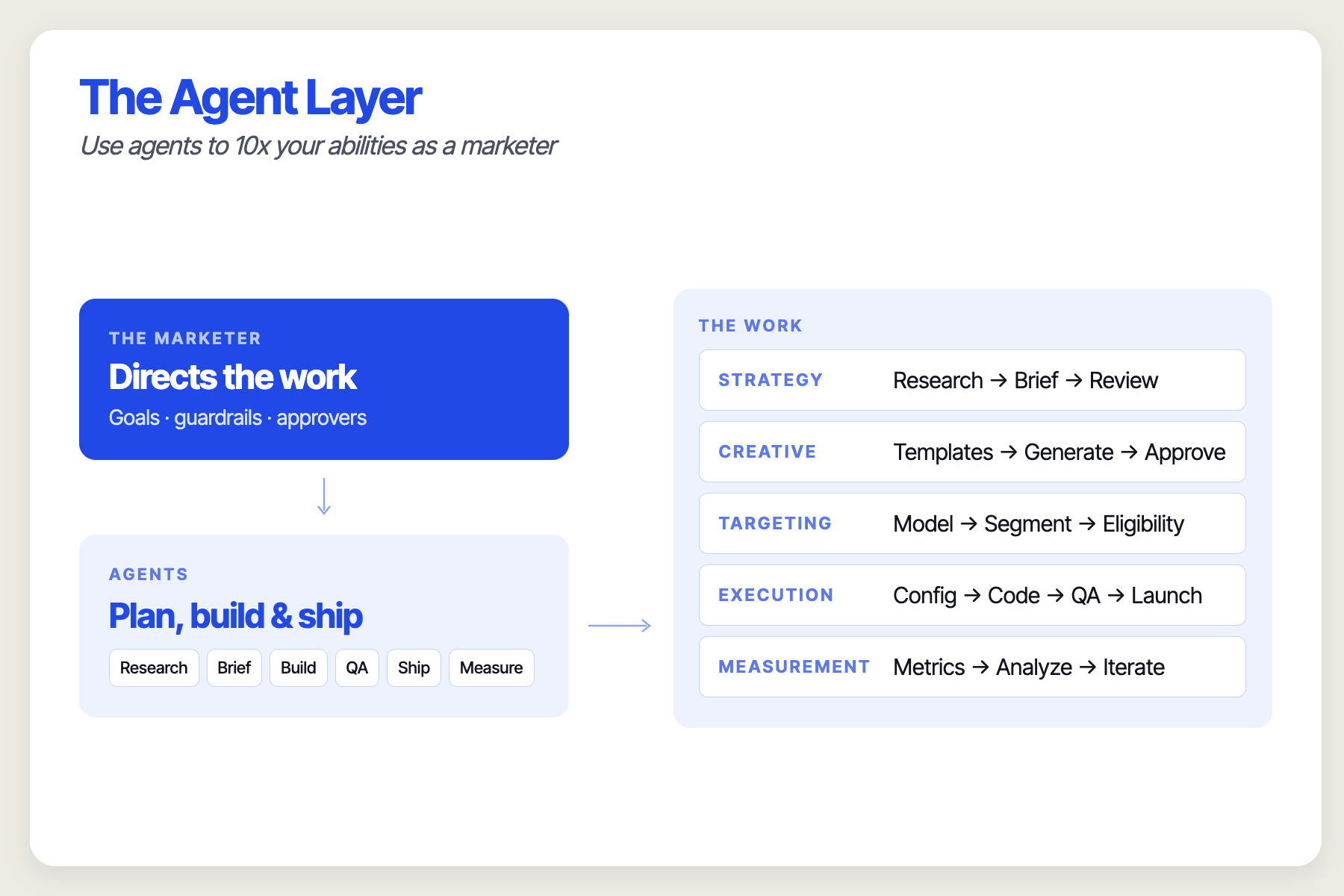
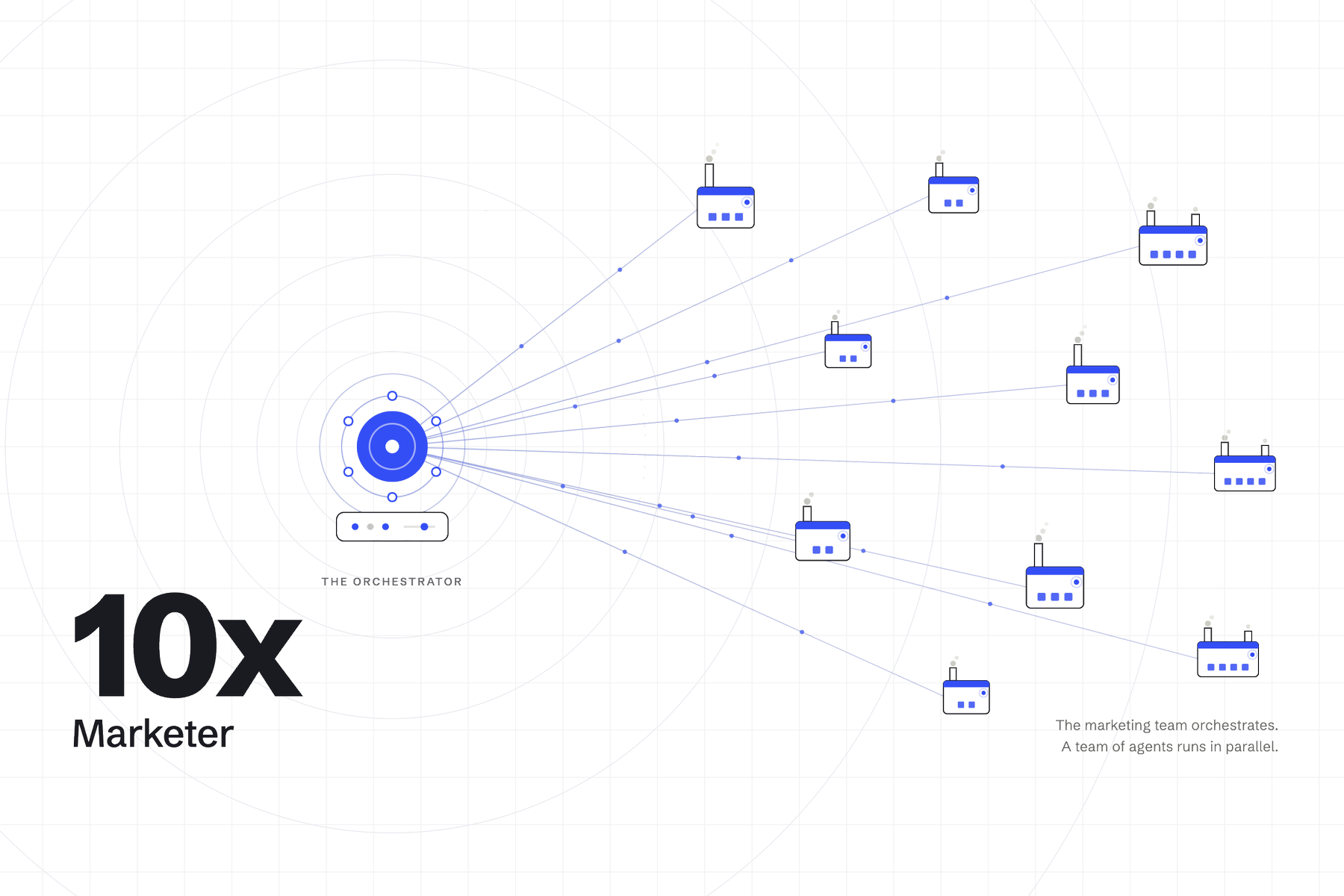
Across every knowledge-intensive industry, agents are taking over the execution layer, the manual, repetitive, coordination-heavy work that used to consume most of a skilled professional's week. Marketing is no exception. When agents handle execution, optimization, and coordination, the marketer's job shifts from managing the assembly line to orchestrating the entire factory.
So what does that do to the stack you’re running today?
Every marketing leader has lived some version of the same story: a new category of tools shows up, promises to fix the chaos, gets adopted everywhere, and within a few years becomes the chaos it was supposed to fix. We are at one of those inflection points again. To understand where things are going, it helps to look at where they have been.
How we got here
The 2000s: the internet gave marketers a channel that scaled. Email, search, and display meant you could reach millions for a fraction of what broadcast used to cost. Salesforce, Adobe, and the other big platforms grew up here, with much of it acquisition-driven.
The 2010s: data and mobile changed the game. Customer Data Platforms, marketing clouds, and behavioral analytics meant you could finally understand who you were talking to, and segment and target more granularly. This is also when the cloud-native data warehouse became transformative. Instead of every tool hoarding its own copy of customer data, companies started centralizing it in one place they actually owned.
The 2020s: composability won. Once data had a permanent home in the warehouse, the rest of the stack could become modular. You no longer needed a single monolithic suite to get a unified view of the customer. You needed a warehouse and a way to sync data in and out of best-of-breed tools. That is the stack most companies run today, and it has a predictable shape.
Today’s marketing stack

Systems of Truth
- Data warehouse / lake: the center of gravity for all customer data (store)
- CDP: where you build segments (segment)
- CMS / DAM: where you store content (organize)
Systems of Activation
- Ad platforms for acquisition
- Marketing automation and customer engagement platforms for lifecycle campaigns
- A/B testing tools for web and app experiments
Where the stack is going
Over the last decade, the marketing stack evolved in two different directions.
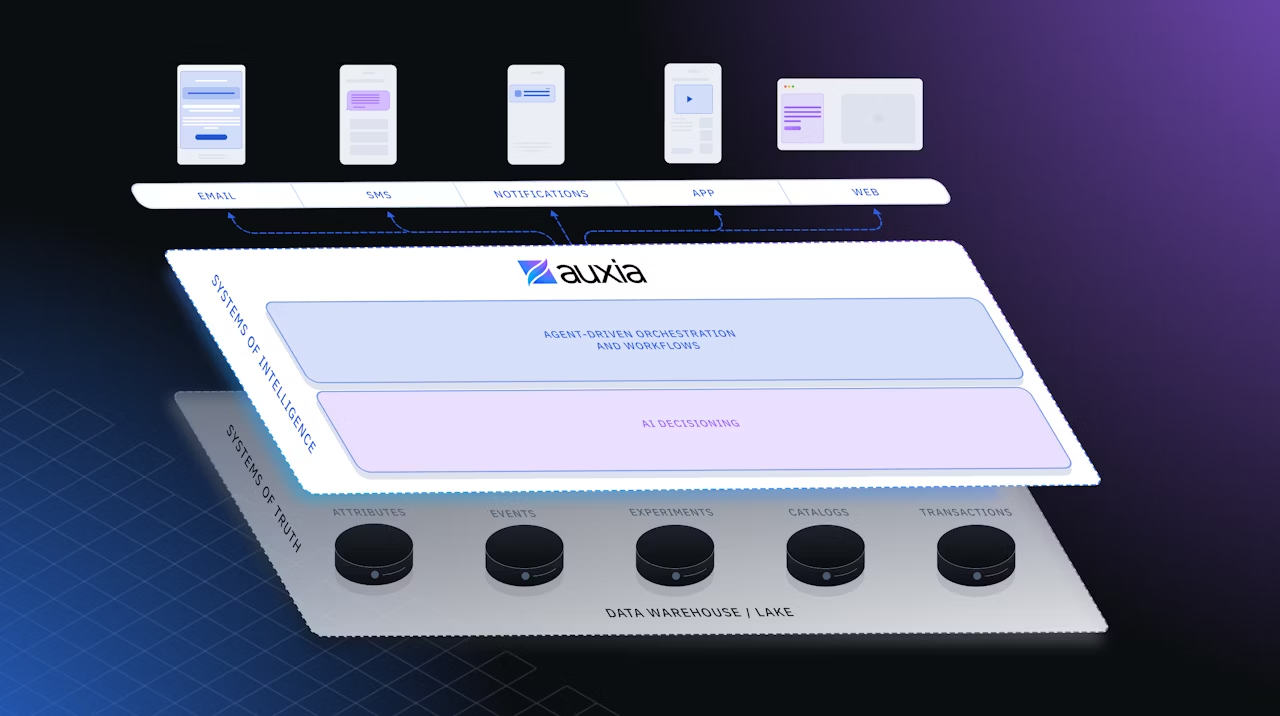
The bottom of the stack became the ‘system of truth’. Warehouses and data lakes consolidated enterprise data into a single source of truth.
The top of the stack became the system of execution. ESPs, journey builders, campaign managers, content tools, and analytics products gave marketers places to plan and launch work.
AI changes both layers simultaneously.
In the past year since my last post on how the industry is ripe for consolidation, we've come to three conclusions.
#1) (No surprise) The data stack is consolidating, with everyone racing to own ‘decisioning’
The first wave of AI adoption taught companies two important lessons.
First, AI delivers fundamentally better customer experiences. Systems that continuously predict, recommend, and adapt outperform systems built around static rules and manual segmentation.
Second, AI only works as well as the context available to it. That has accelerated the push toward centralizing enterprise knowledge rather than scattering it across dozens of applications.
This is why infrastructure companies, like Databricks, keep moving upward. The data warehouse and data lake remain gravity central for the organization, and at Auxia, we don’t see that changing anytime soon. But they're also recognizing there is so much more value customers are looking for than simply storing data. They increasingly want to become the platform that understands business context, serves intelligence to applications, and ultimately owns the decision trace, what happened, why it happened, and what should happen next.
The classic CDP is the layer most at risk. A lot of what a CDP does, building audiences, defining segments, giving marketers control over who gets grouped with whom, is fundamentally about marketers exercising control over targeting. But if AI is deciding who gets what, one to one, you probably won’t need a separate audience-building tool when you’re serving a cohort of one. The capabilities of CDPs certainly will not disappear, but it’s likely you probably won’t need a dedicated product completely separate from that.
.png)
#2) Agents are completely disrupting marketing execution
This is where things get much more interesting. The companies at the top of the stack hold a very important position because they own the marketer's relationship and daily workflows. But agentic systems are disrupting this layer too, and the reason is that most of today's systems were built for execution, a manual UI to carry out actions a person already decided on.
They were not built for intelligence. The strategy, decisioning, and optimization that currently take an army of people and an 18-week campaign cycle increasingly look like things that can run continuously and autonomously.
Take a telecom subscription business trying to win back a customer who has gone quiet.
- Rather than a marketer specifying what creative direction they want to take with an email, the system proposes it proactively. It notices the lapse in engagement and surfaces a win-back campaign on its own, before anyone puts it on the roadmap.
- Rather than defining an audience to target, a model predicts the right content for that specific user at the moment it matters. Instead of slotting her into a generic "at-risk" segment, it decides in real time that she responds better to a product update than a discount, because that is what has worked for her before.
- Rather than spinning up one more win-back sequence to supplement the fifteen already running that nobody can fully audit, the marketer sets goals and guardrails (e.g. protect margin, stay on brand, do not over-message), and lets the system operate inside them, surfacing what worked and what did not without anyone digging for it.
#3) To drive transformative change for your company, you need to adapt both capabilities
Replacing one layer independently is probably not going to cut it.
The companies with the richest business context, best decision making in the world, and incredible model performance will struggle to drive adoption if they aren’t tailor-made for marketers.
The companies with beautiful marketer experiences but no understanding of enterprise context struggle to produce differentiated outcomes.
Over the long term, we expect both of these layers to continue converging. What’s important for you to remember though is that as agents take overt more and more of the manual work, the underlying execution matters less and less. What product you’re using to send an email becomes less important as long as your team can build it 10x faster, reach people 10x more precisely, and deliver 10x higher quality experiences.
This is really the value that agents bring to the table.
What does this mean for my company?
To drive truly transformative change in your organization around marketing and customer engagement, you’ll need three capabilities:
First, you need an omnipresent "brain" across the organization, something that connects to all of your existing context and data rather than sitting next to it as one more disconnected tool. It has to read campaign history, brand guidelines, audience behavior, and past performance well enough to know the business from day one, and get smarter with every campaign that runs.
Second, you need a way to curate the experience for every single user individually. The closest analogy is giving every customer their own marketing agency and their own data scientist. Not a segment they get bucketed into, but a one-to-one read on who they are and what they need.
Lastly, you need a suite of tools that actually takes the operational burden off your teams, because executing on all of it is usually half the battle. Knowing the right move means little if your team still has to manually build, launch, and audit it.
In our view, there’s a few ways you can tackle this:
- Bet on a legacy platform
Most incumbents recognize where the market is headed and are investing in building a lot of these capabilities themselves. The trade off here is that you risk broader organizational transformation by working with companies that are rebuilding decade old platforms with agents that have to remain backward compatible with legacy tech.
- Build all of it, or components, yourself
A lot of companies choose to build their own stack for maximum flexibility and control. If you have the resources and engineering talent, it’s a great option. But companies today don’t have the luxury of waiting a whole year to build it and take their best engineers away to maintain and update it when their board is demanding impact next quarter.
- Partner with an AI-native brand
If you go with a company that has designed their architecture around ML and Agents from the beginning, you can connect to every component of your stack right away and deliver value immediately as your organization evolves. As the capabilities mature, companies can replace legacy execution tools over time, or swap them for lower-cost alternatives, without rebuilding the intelligence layer that sits across them.
The 10x Marketer: Why Agents, Not Tools, Are the Next Unlock in Marketing
Look at almost any knowledge function right now and you will see the same thing happening.
In law, Harvey is drafting briefs, reviewing contracts, and doing due diligence, work that used to require entire associate classes. In software, Cursor and Claude Code are writing code, catching bugs, and synthesizing documentation faster than any engineering team could on its own. In customer experience, Sierra is handling complex service interactions end to end, not routing tickets to a human but actually resolving them.
Every one of these is the same shift: agents taking on execution that used to require a person. Marketing should be next. Arguably, marketing, with its enormous surface area of repetitive, judgment-light execution work, should have been first.
Why most AI in marketing hasn't worked
So why hasn't it happened?
It helps to step back. Every major shift in marketing technology has done the same thing: it raised the ceiling on what a marketer could do. The internet gave us distribution that scaled. The cloud gave us data at a resolution we had never had. Each shift looked, at the time, like the end state. Each turned out to be a stepping stone.
We are now at the start of a third shift, and it’s bigger than the others. This time the unlock is not a new channel or a new dataset. It’s agents, AI that does not just inform a marketer's decisions but actually does the work a marketer's team used to spend its week on.
If you look at where AI has actually landed in marketing today, it’s almost entirely in two places: content generation and ad platforms like those offered by Google and Meta. Everywhere else, the actual orchestration, decisioning, and execution of marketing still runs on humans. That is not for lack of trying. There are three structural reasons most AI initiatives in marketing never move past the pilot stage.
Marketing is deeply tribal. Every company's approach reflects its own history, its own brand voice, its own read on its customers. There is no universal playbook. "Lifecycle marketing" means something completely different at a fintech than it does at a retailer or a media company. Generic automation, the kind trained on a generic notion of best practice, does not survive contact with that level of specificity.
Marketing is profoundly fragmented, and the tooling makes it worse. Brand, performance, lifecycle, and ops already operate in separate worlds, with context that rarely travels between them. Add an agency and the fragmentation compounds: briefs get rebuilt from scratch, institutional knowledge lives in someone else's drive, and the tools on both sides rarely talk. Every handoff is a lossy translation. Every new campaign starts as a negotiation over what was even decided last time.
Marketing is inherently multiplayer. Every initiative touches brand, legal, product, analytics, and leadership before it ships. Approvals are not optional, and stakeholder input is not either. The coordination overhead, routing feedback, chasing sign-offs, reconciling conflicting opinions, eats an enormous share of every marketer's week. Automation that ignores that human coordination layer is not a solution. It is a faster way to generate more work for everyone downstream.
Put together, these three things explain why so much of the martech stack, for all its sophistication, has converged on rigid, rules-based workflows that cannot adapt to real customer behavior, propped up by agencies filling the gaps slowly, expensively, and without ever truly understanding the business they work for. The result is a customer experience that reflects the organization that built it: disjointed, delayed, and frustratingly generic.
This is the real reason the stack does not feel like it is working, even though every individual tool in it might be best in class. The problem was never a tooling gap. It is a context and coordination gap, and that is exactly the gap agents are suited to close, because closing it requires understanding this business, not marketing in general.
What changes when agents do the work
When agents take on execution, optimization, and coordination, the marketer's job stops being to manage the work. It becomes to direct it.
Today, a marketer's week is dominated by building campaigns, maintaining journey logic, and coordinating across tools and teams.
Tomorrow, that same marketer works at a different altitude. They define the objective. They shape the strategy. They set the guardrails. And they review what the system produces, trusting that the execution layer is operating with the accumulated intelligence of every campaign that came before it, not starting from a blank page each time.
That’s the 10x marketer. Not a marketer doing 10x more manual work, but a marketer freed from having to choose between the things worth doing, because the agentic layer underneath can actually do all of it:
- No more tradeoffs on what gets built. Today every roadmap is a triage exercise: which experiments run, which segments get a dedicated journey, which markets get localized. When execution is no longer the constraint, the question stops being "what can we afford to do" and becomes "what is worth doing."
- Weeks compress into days. Building, testing, and launching a campaign is not inherently slow. It is slow because of how many human handoffs sit inside it. Remove the handoffs and the timeline collapses.
- Quality goes somewhere it could not go before. A genuinely unique experience for every individual customer was never going to scale as a manual process. That level of ambition is only possible once execution is no longer rationed.
The best marketing teams two years from now will not be distinguished by headcount or by how many tools sit in their stack. They will be the ones who figured out how to operate as directors of an AI-powered system, giving fewer, better instructions and getting more, better results back.
We started Auxia because we think this shift is real, it is underway, and most of the market is not built for it yet. The teams that get there first will not just move faster. They will be operating a fundamentally different kind of marketing organization.
Of course, none of this works unless the layer underneath the 10x marketer is actually built for it, and getting that layer right changes the shape of the whole stack, and the org chart of the teams that run it.
That is where I will pick up in part two.
100 Billion Decisions And Counting
One year ago, we announced our Series A and made a bet on a fundamentally different approach to marketing. This week, we’re announcing we crossed 100 billion decisions on behalf of our customers.
I'm proud of the milestone, but this number isn't the story. The story is what our customers accomplished in 2025 with a fundamentally different approach to how marketing works at large enterprises.
Here are a few of the outcomes our customers saw:
- $12M in incremental revenue impact from a single enterprise deployment in its first year
- 5x increase in click-through rates
- 84% lift in cross-sell customer lifetime value
- 50x increase in new sign-ups after replacing a legacy rules-based system
Why These Results Look Different
These numbers didn't come from doing the old thing faster or using AI to ideate new subject lines.
They came from replacing the current campaign-based model entirely.
My co-founders and I started Auxia because we saw a gap that kept widening. At Google, we had early exposure to transformative AI, including transformer models in their infancy, and saw what real personalization looks like at scale. But across the broader market, marketers were managing 12 to 14 fragmented tools, sitting on mountains of first-party data they couldn't activate because the platforms they relied on were built for the pre-AI era. AI was getting layered on top, but the underlying model hadn't changed.
Auxia is different in two fundamental ways. First, we optimize across multiple business goals simultaneously — for example deciding whether a customer should be encouraged to make a purchase, try a new offering, or deepen engagement with the brand — balancing these tradeoffs automatically in the context of the business as a whole. Most platforms, even ones that now call themselves "agentic," still optimize for a single objective at a time. Second, we built Auxia to orchestrate the entire customer journey — not just individual messages. Rather than optimizing isolated email, in-app, or SMS experiences as separate systems, Auxia coordinates the sequence of touchpoints a customer experiences across channels, from in-product moments and web experiences, to outbound communication. The system continuously decides what should happen next for each customer and where that interaction should occur.
Customer Wins
In the last year, we secured and expanded partnerships with Fortune 500, Global 2000, and other industry leaders across media, SaaS, insurance, mobile, and entertainment. Our client roster now includes Atlassian, Assurant, The Guardian, Comcast, Mercari, MUFG, and NTT Docomo. We significantly grew our U.S. customer base while maintaining strong traction in international markets, particularly Japan.
When marketing teams see what Auxia can do, they don't stop at one use case. They expand across the business. That’s what drove a 6x growth in monthly decisions per customer and a robust 176% net dollar retention for our business.
Product and Infrastructure
We matched the pace of customer growth with a steady cadence of product and infrastructure milestones:
- Launched our analyst agent, giving every marketer what amounts to a built-in data scientist who can convert complex campaign data into natural language revenue insights
- Introduced an AI-native interface that unifies decisioning, content generation, and insights in a single view, enabling marketing teams to manage AI-driven programs without technical resources
- Scaled the platform to support processing over 10 billion events per day and handling peak loads of 15,000 queries per second, a 3x capacity increase since early 2025
Team and Global Expansion
Last year’s $23.5 million Series A round, led by VMG Technology Partners, accelerated product development and go-to-market expansion, helping us quadruple headcount growth year over year to support our growth. We focus deeply on hiring the right people, and were thrilled to welcome several key additions to our leadership team:
- Rich Anstett joined as Chief Revenue Officer, bringing 25 years leading global GTM teams at companies like SmartRecruiters and Culture Amp
- Yoshi Tsugu is leading our growing presence in Japan
- Eric Barbour joined as VP of Product Marketing
- Key engineering and product leaders Prinka Wadhwa, Nagaraj Hatti, and Siddardha Garimella
We now operate out of Palo Alto, Tokyo, and Bangalore.
Where This Is Going
Behind those 100 billion decisions is something less visible but equally important: a compounding base of context that makes each decision smarter than the last. Every choice Auxia makes — which content to surface, when to intervene, what offer to extend — leaves a trace: the signals available at that moment, the reasoning applied, the outcome that followed. Across millions of interactions, these traces form a context graph specific to each customer's business — the accumulated judgment of their best campaigns and their best marketers, encoded into infrastructure rather than held in their team’s memory. This is why our customers see results that improve over time rather than plateau.
The institutional knowledge that previously lived inside agencies or walked out the door when a team member left now lives inside Auxia and compounds with every decision that flows through it.
And we think that timing matters: the gap between companies that adopt agentic marketing systems and those still running on campaigns and segments is going to widen fast. The companies that move now will compound their advantage in data, in customer experience, and in revenue.
That's the real significance of 100 billion decisions. Not the number, but the proof that this works. The future isn't AI replacing humans. It's humans and AI agents working together to make decisions that are faster, smarter, and more impactful.
That's what we're building at Auxia.
Integrating AI Agents Across 5 Key Marketing Functions
AI agents are revolutionizing marketing departments across industries, moving beyond simple automation tools to become intelligent partners in campaign strategy and execution. Today's marketing teams are integrating these sophisticated systems into nearly every stage of their processes, from creative generation to data analysis.
This transformation represents a fundamental shift in how marketing operates. Rather than replacing human creativity and strategic thinking, AI agents amplify these capabilities while handling the heavy lifting of execution, optimization, and analysis. The result is faster, more personalized, and data-driven marketing that would be impossible with human resources alone.
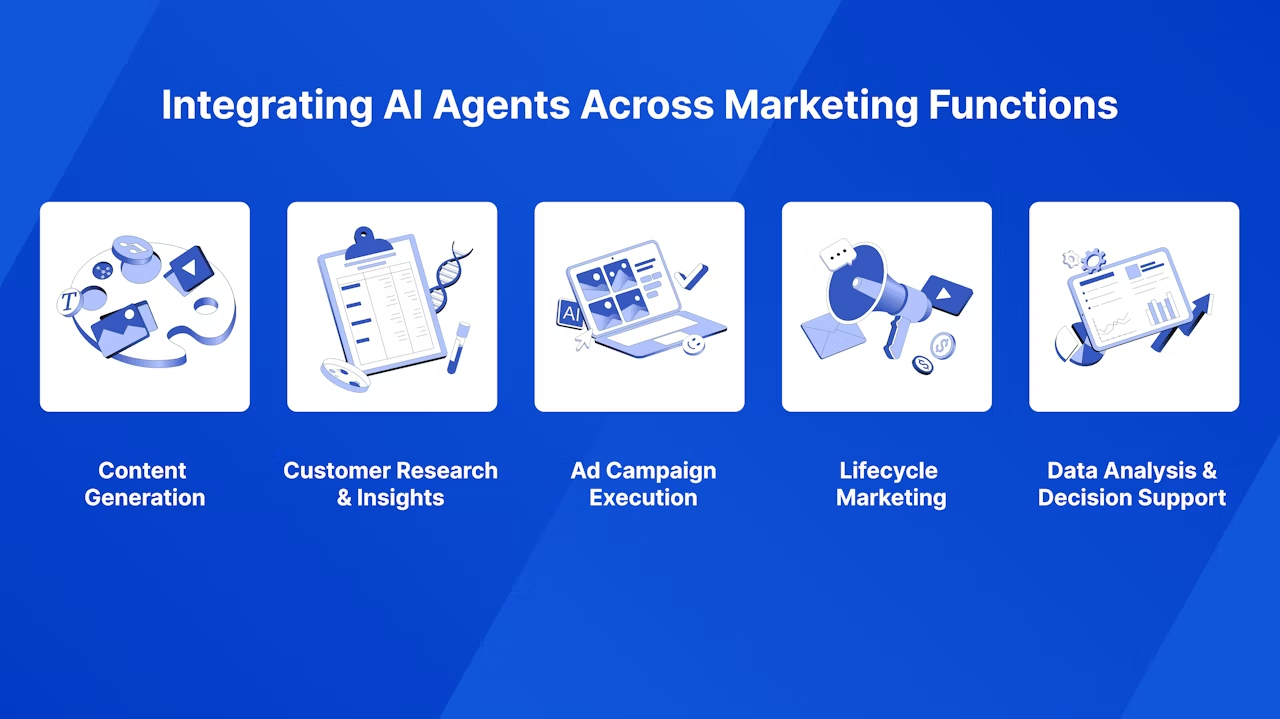
This article explores the role of AI agents in five core areas of the marketing workflow.
1. Creative Content Generation: From Weeks to Hours
The creative process—producing ads, copy, and visuals for campaigns—has been dramatically accelerated by generative AI agents. Tasks that once required teams of copywriters and designers working for weeks can now be completed in hours.
Coca-Cola's "Create Real Magic" Success Story
In 2023, Coca-Cola launched its "Create Real Magic" platform, enabling users to co-create artwork using GPT-4 and DALL·E. The results were staggering: over 120,000 pieces of unique content created in just a few months. But the impact extended beyond external campaigns.
Internally, Coca-Cola's marketers now use generative AI tools for design and ideation. As Selman Careaga, President of ASEAN & South Pacific category at Coca-Cola, explained: "Whether it's research or analytics that can create better insights... or using AI as a tool together with our human insights team to come up with more relevant ideas." The company's human creatives partner with AI agents to generate ad copy, social posts, and even flavor concepts—as seen in its AI-developed Y3000 limited-edition drink.
Practical Efficiency Gains
At a more operational level, e-commerce retailer Adore Me automated product description creation with AI. This mundane but necessary task previously consumed 30-40 hours per month. An AI writing agent reduced this to just one hour—a 97% time savings that freed up human resources for strategic work.
These examples demonstrate that across industries, AI content agents help teams generate and iterate on creative materials at unprecedented speed, while humans provide brand guidelines and final approval.
2. Customer Research & Insights: Mining Insights at Scale
The very foundation of effective marketing is a deep understanding of customers: their needs, preferences, and opinions. AI agents are revolutionizing this process by analyzing vast data sources and surfacing actionable insights in record time.
Instead of human analysts manually sifting through survey responses or social media comments, AI research agents use natural language processing to aggregate and summarize sentiments from thousands of data points. Early implementations across industries include:
- Consumer goods companies analyzing call center transcripts and online reviews to identify product issues and opportunities
- B2B marketers researching target accounts by examining public financial reports, news, and LinkedIn data
- Market research firms experimenting with AI moderators that autonomously conduct customer interviews via chatbot and compile findings
This shift enables marketing teams to base strategies on comprehensive data analysis rather than limited sample sizes or intuition alone.
3. Ad Campaign Execution: Real-Time Optimization at Scale
Once marketing creative and plans are finalized, executing campaigns across multiple channels becomes a complex operational challenge. AI agents excel as tireless coordinators, automating routine steps, optimizing performance in real-time, and making proactive adjustments.
Google's Performance Max: AI in Action
Google's Performance Max essentially functions as an AI agent for advertisers. It autonomously manages campaigns across Search, YouTube, Gmail, Maps, and other platforms, allocating budget and adjusting placements to meet specified goals. Marketers simply provide objectives and creative assets, while AI handles granular execution, continuously learning which audiences and messages perform best.
This cross-channel optimization reacts in real-time to shifts in consumer behavior, something manual optimization would accomplish far more slowly.
Enterprise Implementation Examples
Enterprise marketing teams are embedding agents throughout their campaign operations. Accenture uses autonomous agents to run large campaigns with minimal human intervention, achieving notable efficiency gains. Retail giant Carrefour's AI marketing studio not only personalizes content but automatically adapts creatives for different social platforms, accelerating campaign rollout across Facebook, Instagram, and other channels.
The common thread is real-time decision-making: these agents can pause underperforming ads, redistribute budget to top-performing channels, or recommend email send time changes by analyzing engagement data instantly. Humans set strategy and guardrails while AI agents handle rapid response tactics, creating campaigns that are "always on" with 24/7 optimization.
4. Lifecycle Marketing: User-Level Personalization
Lifecycle marketing focuses on engaging customers with the right message at each stage of their journey—onboarding, retention, win-back, and beyond. AI agents excel at analyzing customer data and orchestrating personalized touchpoints at scale.
Starbucks' Deep Brew Success
Starbucks relies on an AI engine called Deep Brew to power hyper-personalized offers for Rewards members. Deep Brew functions as a behind-the-scenes marketing agent, mining loyalty and app data to recommend products and promotions tailored to individual customers. It might suggest a new drink based on past orders or time a discount when a lapsed customer is due for a repeat visit.
The system considers contextual factors like weather, local events, and time of day to optimize engagement. The impact has been substantial: personalized recommendations drove higher visit frequency and larger ticket sizes, contributing to mobile orders now representing 30%+ of U.S. transactions.
Advanced Personalization and Targeting
AI agents like Auxia's Decision Agent deploy adaptive, ultra-personalized campaigns across channels. These systems automatically rank, score, and predict the optimal form of content (e.g. email, SMS, etc) for each user based on their behavior or preferences to serve the best journey for that person. This ensures each individual receives far more timely and relevant outreach, which results in far better performance than what manual segmentation could achieve.
5. Data Analysis & Decision Support: 24/7 Marketing Intelligence
Modern marketing generates enormous amounts of data—campaign metrics, web analytics, CRM data, sales figures, and more. AI agents are being deployed to process this information and support faster, better decision-making.
These agents function as intelligent marketing analysts that work around the clock. An AI analyst agent continuously monitors campaign KPIs across channels, alerting teams when something notable occurs like a sudden drop in conversion rates or an ad trending below benchmarks. Rather than waiting for monthly analytics reviews, marketing leaders receive real-time insights, produce executive-ready reports, and highlight trends or anomalies as they happen.
Workflow Transformation: Before and After AI Agents
To illustrate the practical impact, consider how AI agents transform a typical email campaign workflow:
Traditional Approach
A human marketing manager relies on a data scientist or engineer to create segments of their customer base using database queries, marketing automation rules, or (in the most advanced teams) predictive models. They collaborate with copywriters to develop email content and design, set up A/B tests for the subject lines and body, then schedule and send the campaign. Over the following days, they manually monitor performance metrics, export data to spreadsheets for analysis, and eventually prepare reports to guide follow-up actions. This process involves multiple handoffs and considerable time investment.
AI-Agent Enhanced Approach
A "Content" agent generates multiple email variations based on all the hypotheses your team has on what will drive a customer to convert. After a human marketer reviews and approves these drafts, a “Decision” agent automatically analyzes customer data, leverages machine learning to discover behavioral patterns for each individual customer, and serves the optimal variation for each person based on what’s predicted to have the highest impact.
As the campaign runs, it monitors performance in real-time, proactively adjusting the emails that are distributed for each individual within pre-approved guardrails. Simultaneously, an "Analyst" agent autonomously processes live data, integrating email statistics with web traffic and sales conversions to identify hidden trends.
When specific clusters of customers outperform others, the “Analyst” agent alerts the team and recommends specific re-engagement strategies for the underperforming group. Post-campaign, it auto-generates comprehensive reports with key insights and actionable recommendations.
In this scenario, the marketer's role shifts to strategic oversight: reviewing AI-generated content, approving agent suggestions, and providing direction. The heavy lifting of execution and analysis is automated, compressing timelines from weeks to days while enabling rapid, data-driven adjustments that human teams might miss or implement too slowly.
Overcoming Implementation Challenges
Despite their promise, AI agents face several key adoption barriers:
Trust and Oversight
As AI agents take on more autonomous roles, companies need robust guardrails to ensure brand safety and accuracy. Marketing involves creativity and nuance that AI can mishandle—a tone-deaf automated social post can create PR disasters. Building trust requires implementing review checkpoints, maintaining "human veto" power, and creating transparent logs of agent decisions. Until marketers trust AI systems, they'll remain reluctant to grant autonomous authority.
Data Integration and Quality
AI agents are only as effective as the data they receive. Many marketing teams still operate with data silos—separate CRM, web analytics, and event collection streams—along with data quality issues. Autonomous workflows require unified, clean data streams for effective AI reasoning. Setting up these integrations while ensuring accuracy represents a significant technical hurdle.
Real-time data access is crucial for proactive agents. Any latency or batch processing limitations can severely restrict an AI's ability to react quickly to changing conditions.
Skills and Change Management
Adopting AI agents requires marketers to develop new competencies, from prompt engineering to interpreting AI outputs and managing exceptions when systems escalate issues to humans. Cultural resistance and anxiety must be addressed, as 43% of marketers who haven't embraced AI worry about becoming too reliant on these tools.
Successful companies approach this in a number of ways. Some embed AI within every team and role at the company, while others create internal "AI task forces" or centers of excellence to coordinate initiatives and provide training. Both approaches can work, but it typically depends on the stage of the organization, how AI-native the workforce is, and what your enterprise’s goals are.
Strategic Implementation Focus
With significant AI hype, many teams experiment with agents without clear plans, leading to scattered pilots that never scale. Best practices emphasize starting with specific workflow pain points—"producing weekly reports is slow" or "social media monitoring is overwhelming"—then deploying targeted agents to solve these problems.
Early wins, like Adore Me's 97% time reduction in product copy generation, build momentum for broader implementation. However, not every marketing task benefits from AI automation; some creative and strategic functions still require human-led approaches.
The Future of Human-AI Marketing Collaboration
AI agents are transforming marketing from a primarily human-intensive craft into a sophisticated collaboration between human creativity and machine efficiency. Today's marketing teams may use AI writing assistants, analytics bots, and automated schedulers—but this represents only the beginning.
As enterprises integrate these agents into unified systems, marketing workflows will become increasingly intelligent and autonomous. We're witnessing marketing departments evolve into augmented teams where humans provide strategic direction and ensure brand integrity, while AI agents handle execution, data processing, and routine decision-making.
The industry sits at a crucial turning point. The foundational pieces—generative AI, integration APIs, preliminary trust frameworks—are in place. Forward-thinking companies are assembling them to reinvent campaign management entirely. While most marketers remain in early adoption phases, trailblazers have demonstrated the potential.
Over the next 1-3 years, expect more marketing functions to incorporate proactive AI assistants and limited autonomy. Each success will build confidence to push boundaries further, likely creating hybrid human-AI teams capable of achievements in personalization, scale, and speed that purely human teams could never accomplish.
Conclusion: AI Doesn’t Replace Marketers, It Augments Them
The adoption of AI agents in marketing isn't about replacing human creativity or strategic insight—it's about amplifying these uniquely human qualities with machine efficiency and intelligence. In marketing, embracing AI agents means reimagining workflows and roles so that the combination of humans plus AI exceeds what either could achieve alone. Organizations that master this human-in-the-loop, multi-agent model will lead marketing innovation, delivering more personalized and impactful campaigns while competitors struggle to keep pace.
The era of AI-agent augmented marketing has arrived, promising a future where creative strategy and algorithmic execution work hand in hand to drive sustainable growth. The question isn't whether AI agents will transform marketing—it's how quickly your organization will adapt to harness their full potential.
Ready to learn more about Auxia? Schedule a demo.

AI Agents in Marketing Workflows: From Co-Pilots to Autonomous Campaigns
The marketing landscape is experiencing a fundamental shift. What began as rule-based automation—triggered emails, scheduled social posts, basic segmentation—is evolving into something far more sophisticated. Today's AI agents don't just execute predefined workflows; they observe, learn, and make decisions that were once the exclusive domain of human marketers.
This transformation represents more than technological advancement; it's a reimagining of how marketing teams operate. Where marketers once spent hours analyzing campaign performance, AI agents now continuously optimize in real time. Where creative teams labored over endless A/B test variations, intelligent systems generate and test hundreds of permutations simultaneously. Where campaign managers juggled complex multi-channel orchestration, autonomous agents seamlessly coordinate across touchpoints without human intervention.
Yet this evolution raises profound questions about the future of marketing work itself. As AI agents move from helpful co-pilots to fully autonomous campaign managers, we must grapple with what this means for creativity, strategic thinking, and the fundamentally human aspects of brand building. The challenge isn't simply technical, it's organizational, creative, and philosophical.
This article explores the spectrum of AI agency in marketing, from today's sophisticated assistants to tomorrow's autonomous campaign orchestrators.
The Emergence of Multi-Agent Marketing Teams
Marketing teams are evolving into multi-agent systems where human marketers lead networks of AI-driven specialists. Rather than replacing humans, these AI agents serve as collaborative co-pilots embedded throughout the marketing lifecycle—from planning and creative generation to execution and analysis.
This creates a new organizational model: humans-in-the-loop guiding specialized AI assistants. Success requires rethinking workflows beyond simple one-to-one mappings of human job titles to AI tools. Instead, it's about designing intelligent information flows and determining when human oversight should intervene to ensure seamless AI-human collaboration.
In this model, human marketers become orchestrators and quality controllers, supervising agent "colleagues" that hand off tasks to one another in modular pipelines. This balanced approach maintains trust and contextual awareness while embedding AI agents deeper into marketing operations.
The Five Stages of Agentic Maturity in Marketing
Not all AI agent deployments are equal; they vary widely in sophistication and autonomy. We can categorize the maturity of agent integration in marketing teams into five stages (adapted from the general maturity model suggested by Scott Belsky):
Stage 1: Glorified Personalized Help: At this most basic level, the AI functions like a smart FAQ or assistant that provides personalized answers or content recommendations when asked. In marketing, this might be a chatbot that can retrieve information (“What was our Q3 ad spend on channel X?”) or a simple content suggestion tool. It’s helpful, but essentially reactive and one-step. Many early marketing AI tools (like FAQ chatbots on websites or basic personalization rules engines) fall into this category; they tailor outputs to the user, but don’t do any multi-step reasoning or proactive work.
Stage 2: Reactive Recommendations: Here, the agent can do some work on your behalf upon request. Marketers input a prompt or command, and the agent produces something useful, often assembling data or content. For example, an AI that generates an email draft or a social media calendar on demand based on parameters you give is at this stage. Most current "AI in marketing" tools operate at this stage. The agent doesn't act unprompted but can handle complex tasks when directed, delivering prepared assets or analyses that save significant marketer effort.
Stage 3: Proactive Recommendations: At this stage, the agent starts to anticipate needs and suggest actions without being explicitly asked each time. In a marketing context, an agent might observe your campaign setup and proactively suggest, “Based on previous campaigns, you may want to add a promotional message via notifications for audience X.” Or an Analyst agent might send a suggestion, “Key insight: users from segment Y are trending down, perhaps create a re-engagement campaign.” These recommendations are not user-prompted but context-triggered. Achieving this reliably often requires the agent to have a degree of situational awareness (e.g., access to live campaign data or content creation workflow state). While still relatively rare in 2025, we are starting to see early examples: some advanced systems will proactively learn and flag opportunities as agents gain better contextual awareness and predictive capabilities. This moves the AI from a passive tool to more of an active advisor on the marketing team.
Stage 4: Proactive Actions: Now the agent goes beyond suggesting; it takes actions autonomously (or semi-autonomously) when it sees an opportunity, while keeping a human in the loop. In marketing, this could mean an AI agent that doesn’t just recommend adding a channel or adjusting an ad bid, but actually executes the change: for instance, pausing a poorly performing ad on its own, or launching a test it thinks will improve results, then informing the team of what it did. At this stage, the AI behaves like a junior colleague who can “work side by side” with human marketers. We see early glimpses of this in areas like programmatic advertising (where the system allocates budget across creatives in real time) and some coding co-pilot agents have reached this stage (making code changes proactively). For broader marketing applications, Stage 4 action agents are just beginning to emerge.
Stage 5: Autonomous Workflows: The most advanced stage is a fully autonomous marketing workflow run by one or multiple agents with minimal human input beyond high-level goals. This is the vision of an AI agent (or a team of agents) that can carry out an entire marketing process end-to-end: for example, conceive a campaign for a new product, allocate budget, produce content, deploy across channels, and optimize – all autonomously, “negotiating with other agents on our behalf” if needed and only asking for human sign-off at key checkpoints. In theory, such an autonomous marketing agent could be given an objective (e.g., “Launch a campaign to increase subscriptions by 10% among Millennials in Q3”) and it would handle the rest, within guardrails. Currently, this level exists primarily in experimental forms, with the closest examples being Google's Performance Max and Meta's Advantage+ automated campaign systems. True autonomous marketing workflows remain largely aspirational.
Current State and Future Outlook
Most organizations in 2025 are transitioning from Stages 1 and 2 into Stage 3, with leading-edge cases exploring Stage 4. According to product leader Scott Belsky, most startups pitching agent-based functionality still operate in the "Reactive Recommendations" category.
Truly proactive marketing agents that reliably anticipate needs (Stage 3) are just beginning to appear, though Belsky notes, "I have not seen many great examples of this yet, but they are coming." Stage 4 proactive action agents are emerging in specialized applications like programmatic advertising, while Stage 5 full autonomy remains a near-future aspiration.
Navigating the Human-AI Partnership in Marketing's Future
The path forward requires more than simply deploying the most advanced AI tools available—it demands a fundamental reimagining of how marketing organizations structure themselves, allocate responsibilities, and maintain competitive advantage in an increasingly automated landscape.
Building AI-Native Marketing Teams
Organizations that succeed won't bolt AI agents onto existing processes, but will redesign their marketing operations around human-AI collaboration from the ground up. The most effective teams will operate as hybrid intelligence networks, where human creativity and strategic intuition guide AI execution and optimization. Human marketers will focus on high-level strategy, brand positioning, and emotional resonance, while AI agents handle execution, testing, and real-time optimization that scale beyond human capacity.
The Trust and Control Challenge
As AI agents become more autonomous, marketing leaders face a critical balancing act: capturing automation's efficiency gains while maintaining control over their brand's voice and actions. Success requires establishing robust governance frameworks early—defining clear boundaries for AI decision-making and creating feedback loops that preserve brand authenticity and customer relationships. The most sophisticated AI can optimize for engagement metrics, but human judgment ensures those optimizations align with long-term brand values.
The New Competitive Landscape
As AI capabilities democratize, sustainable advantage will shift from having access to tools to how thoughtfully organizations integrate them. The brands that thrive will use AI agents not to replace human creativity, but to amplify it—freeing marketers for the work that truly differentiates: understanding deep customer needs, crafting compelling narratives, and making strategic bets in crowded markets.
Organizations should focus on mastering Stages 2 and 3 before rushing toward full automation, investing in the infrastructure and cultural changes needed for effective human-AI collaboration. Most importantly, this means maintaining sight of marketing's ultimate purpose: connecting with human needs and emotions in ways that create lasting value.
The future belongs to organizations that embrace this partnership, leveraging AI agents as collaborative tools while preserving the human elements that create truly memorable brands. Success won't be measured by how much human work AI can replace, but by how much human potential AI can unlock.
Ready to learn more about Auxia? Schedule a demo.
The Great Marketing Stack Consolidation: Why Point Solutions Are Dead
The Fragmentation Crisis
After speaking to dozens of marketing teams over the past year, the first clear theme that emerges from conversations with CMOs, CTOs, and CIOs is that they are tired of managing a plethora of point solutions.
The numbers tell the story: even mid-sized companies typically operate multiple different solutions in their marketing stack. Each tool was implemented to solve a specific pain point—email automation here, customer data platform there, A/B testing in another corner. But what marketing leaders are discovering is that all of these tools have their own silos, with absolutely no cognition, cohesion, or unified customer point of view.
The hidden costs extend far beyond software licensing. Companies invest millions in integration specialists, data engineers, and agency staff just to make these disparate systems work together. It’s not unheard of to spend more on the people managing a marketing stack than on the technology itself.
Most frustrating of all is the personalization paradox: despite having more marketing technology than ever before, most companies struggle to deliver truly personalized experiences. Rules-based systems and batch processing create experiences that feel generic and disconnected from real customer behavior.
The Convergence: Technical Enablers
Two fundamental technological shifts have converged to make marketing stack consolidation not only possible but inevitable.
The first is the maturation of cloud-native data warehouses. Since Snowflake’s emergence in 2015, enterprises have invested billions of dollars in getting all their data into centralized, accessible repositories. For the first time, companies have a true single source of truth for customer information: structured transaction data, unstructured behavioral signals, and everything in between, all sitting in one place.
The second enabler is the transformer architecture revolution that powers modern large language models. These advances allow AI systems to understand and process both structured and unstructured data at unprecedented scale and speed. What previously required extensive data science teams and weeks of analysis can now happen in real-time, enabling immediate decision-making based on the most current customer behavior.
Combined with improved API accessibility, these technologies create the foundation for a fundamentally different approach to marketing technology; one where intelligence, rather than data movement, becomes the primary value driver.
The New Architecture: Intelligence Layer
The future marketing stack looks dramatically different from today’s fragmented landscape. Instead of separate tools for data collection, storage, analysis, and activation, a new intelligence layer sits between your data warehouse and customer touchpoints.
This intelligence layer represents a complete paradigm shift. Rather than moving data between systems and applying rigid rules, AI agents make dynamic decisions in real-time based on complete customer context. A decision agent determines the optimal action for each individual customer. An analyst agent continuously evaluates performance and suggests improvements. Content agents create and optimize messaging and creative elements so teams can focus on more strategic priorities.
The result is continuous optimization rather than periodic campaign adjustments. Instead of running A/B tests for weeks to determine what works, the system learns and adapts continuously, testing hundreds of variations and automatically promoting the most effective approaches.
This architecture eliminates the need for most traditional point solutions. Why maintain separate tools for audience segmentation, experimentation, personalization, and analytics when a single intelligence layer can handle all these functions more effectively?
Real-World Results
Companies implementing unified AI-driven platforms are already seeing dramatic results. Take two recent examples from our work at Auxia: a leading international marketplace with billions in gross merchandise value achieved an 84% increase in customer lifetime value by replacing their fragmented, segment-based campaigns with Auxia’s user-level AI decisioning engine. Meanwhile, a global financial institution with over $500 billion in assets boosted onboarding completion rates by 50% while conducting 22 times more experiments than their previous system allowed.
The breakthrough in both cases came from moving beyond rules-based segmentation to AI systems that consider complete customer context—purchase history, real-time behavior and demographic signals—to make optimal decisions in milliseconds rather than the weeks required for traditional A/B testing cycles.
The Choice Ahead
What makes this consolidation wave different from previous enterprise software cycles is the capabilities it unlocks. After years of marketing technology breaking apart into specialized point solutions, AI is now driving them back together—but with fundamentally new possibilities.
Take real-time personalization as an example. Most systems today claim to be real-time, but they’re really not.
Here’s what true real-time looks like: when someone looks for a product in the fashion category on a digital marketplace, AI algorithms can immediately analyze what they just bought and determine the optimal next category to surface—maybe sports memorabilia—along with the specific subcategories and incentives most likely to drive a cross-sell. This decision happens in milliseconds, based on that individual’s complete purchase history, browsing behavior, and demographic signals.
That kind of in-session decision-making, based on complete customer context, simply wasn’t feasible with fragmented tools. Traditional systems might recommend similar products—more jeans if you bought jeans—but they can’t make the intelligent leap to complementary categories that actually increase lifetime value.
The companies getting breakthrough results today understand this goes beyond buying new technology. They’re reimagining how marketing teams operate when AI agents can handle the analysis that used to require teams of consultants.
Marketing leaders can either drive this consolidation proactively or be forced to react as competitive pressures mount. The enterprises that embrace this transformation early will set customer expectations for personalized experiences that fragmented systems simply can’t match.