

The 10x Marketer: Why Agents, Not Tools, Are the Next Unlock in Marketing


Look at almost any knowledge function right now and you will see the same thing happening.
In law, Harvey is drafting briefs, reviewing contracts, and doing due diligence, work that used to require entire associate classes. In software, Cursor and Claude Code are writing code, catching bugs, and synthesizing documentation faster than any engineering team could on its own. In customer experience, Sierra is handling complex service interactions end to end, not routing tickets to a human but actually resolving them.
Every one of these is the same shift: agents taking on execution that used to require a person. Marketing should be next. Arguably, marketing, with its enormous surface area of repetitive, judgment-light execution work, should have been first.
Why most AI in marketing hasn't worked
So why hasn't it happened?
It helps to step back. Every major shift in marketing technology has done the same thing: it raised the ceiling on what a marketer could do. The internet gave us distribution that scaled. The cloud gave us data at a resolution we had never had. Each shift looked, at the time, like the end state. Each turned out to be a stepping stone.
We are now at the start of a third shift, and it’s bigger than the others. This time the unlock is not a new channel or a new dataset. It’s agents, AI that does not just inform a marketer's decisions but actually does the work a marketer's team used to spend its week on.
If you look at where AI has actually landed in marketing today, it’s almost entirely in two places: content generation and ad platforms like those offered by Google and Meta. Everywhere else, the actual orchestration, decisioning, and execution of marketing still runs on humans. That is not for lack of trying. There are three structural reasons most AI initiatives in marketing never move past the pilot stage.
Marketing is deeply tribal. Every company's approach reflects its own history, its own brand voice, its own read on its customers. There is no universal playbook. "Lifecycle marketing" means something completely different at a fintech than it does at a retailer or a media company. Generic automation, the kind trained on a generic notion of best practice, does not survive contact with that level of specificity.
Marketing is profoundly fragmented, and the tooling makes it worse. Brand, performance, lifecycle, and ops already operate in separate worlds, with context that rarely travels between them. Add an agency and the fragmentation compounds: briefs get rebuilt from scratch, institutional knowledge lives in someone else's drive, and the tools on both sides rarely talk. Every handoff is a lossy translation. Every new campaign starts as a negotiation over what was even decided last time.
Marketing is inherently multiplayer. Every initiative touches brand, legal, product, analytics, and leadership before it ships. Approvals are not optional, and stakeholder input is not either. The coordination overhead, routing feedback, chasing sign-offs, reconciling conflicting opinions, eats an enormous share of every marketer's week. Automation that ignores that human coordination layer is not a solution. It is a faster way to generate more work for everyone downstream.
Put together, these three things explain why so much of the martech stack, for all its sophistication, has converged on rigid, rules-based workflows that cannot adapt to real customer behavior, propped up by agencies filling the gaps slowly, expensively, and without ever truly understanding the business they work for. The result is a customer experience that reflects the organization that built it: disjointed, delayed, and frustratingly generic.
This is the real reason the stack does not feel like it is working, even though every individual tool in it might be best in class. The problem was never a tooling gap. It is a context and coordination gap, and that is exactly the gap agents are suited to close, because closing it requires understanding this business, not marketing in general.
What changes when agents do the work
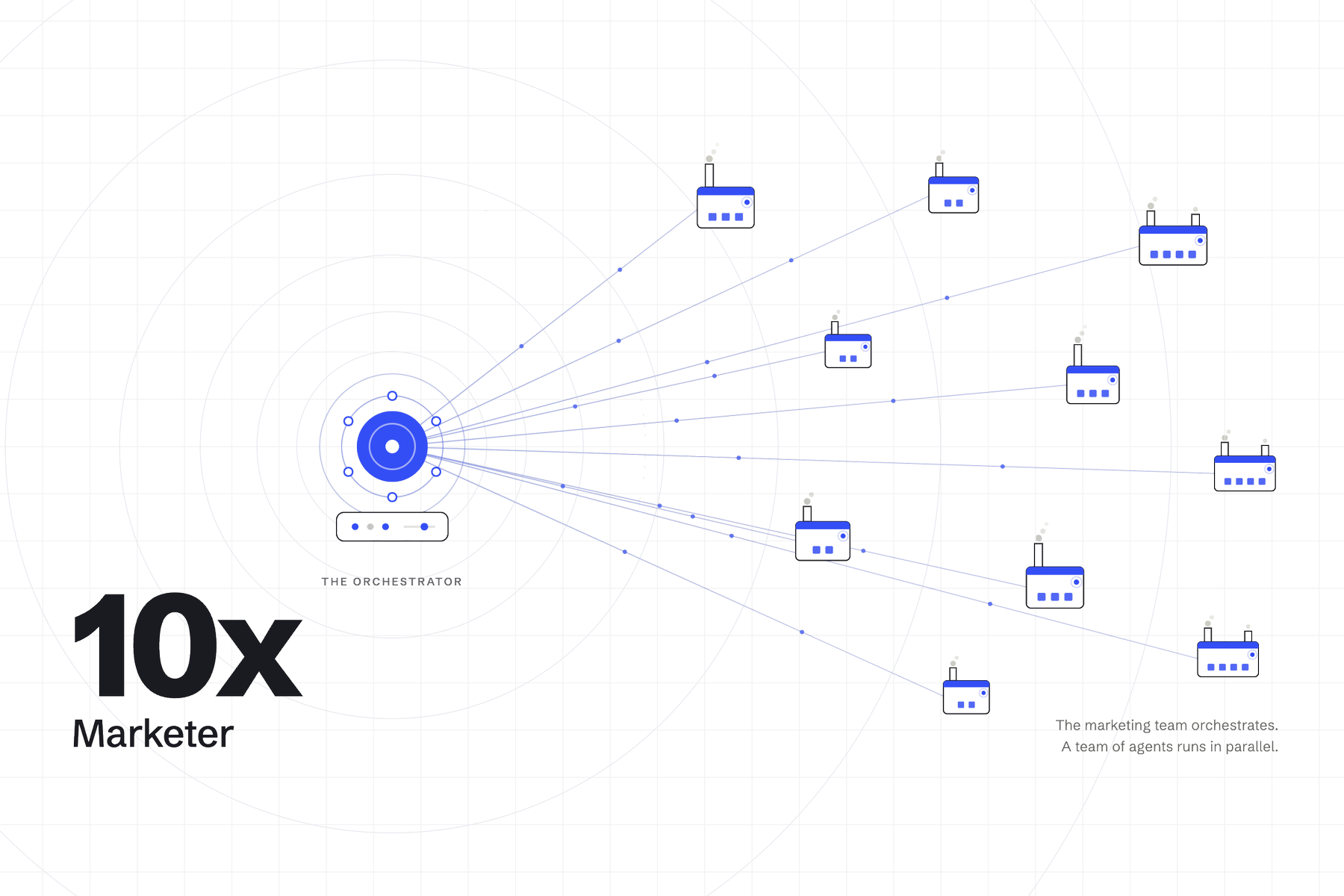
When agents take on execution, optimization, and coordination, the marketer's job stops being to manage the work. It becomes to direct it.
Today, a marketer's week is dominated by building campaigns, maintaining journey logic, and coordinating across tools and teams.
Tomorrow, that same marketer works at a different altitude. They define the objective. They shape the strategy. They set the guardrails. And they review what the system produces, trusting that the execution layer is operating with the accumulated intelligence of every campaign that came before it, not starting from a blank page each time.
That’s the 10x marketer. Not a marketer doing 10x more manual work, but a marketer freed from having to choose between the things worth doing, because the agentic layer underneath can actually do all of it:
- No more tradeoffs on what gets built. Today every roadmap is a triage exercise: which experiments run, which segments get a dedicated journey, which markets get localized. When execution is no longer the constraint, the question stops being "what can we afford to do" and becomes "what is worth doing."
- Weeks compress into days. Building, testing, and launching a campaign is not inherently slow. It is slow because of how many human handoffs sit inside it. Remove the handoffs and the timeline collapses.
- Quality goes somewhere it could not go before. A genuinely unique experience for every individual customer was never going to scale as a manual process. That level of ambition is only possible once execution is no longer rationed.
The best marketing teams two years from now will not be distinguished by headcount or by how many tools sit in their stack. They will be the ones who figured out how to operate as directors of an AI-powered system, giving fewer, better instructions and getting more, better results back.
We started Auxia because we think this shift is real, it is underway, and most of the market is not built for it yet. The teams that get there first will not just move faster. They will be operating a fundamentally different kind of marketing organization.
Of course, none of this works unless the layer underneath the 10x marketer is actually built for it, and getting that layer right changes the shape of the whole stack, and the org chart of the teams that run it.
That is where I will pick up in part two.


.png)