
The CMO's Guide to the Changing Marketing Stack

.png)

The CMO's Guide to the Changing Marketing Stack
In part one, I argued that the next unlock in marketing is agents, not tools, and that what has been holding marketing back is a context and coordination gap.
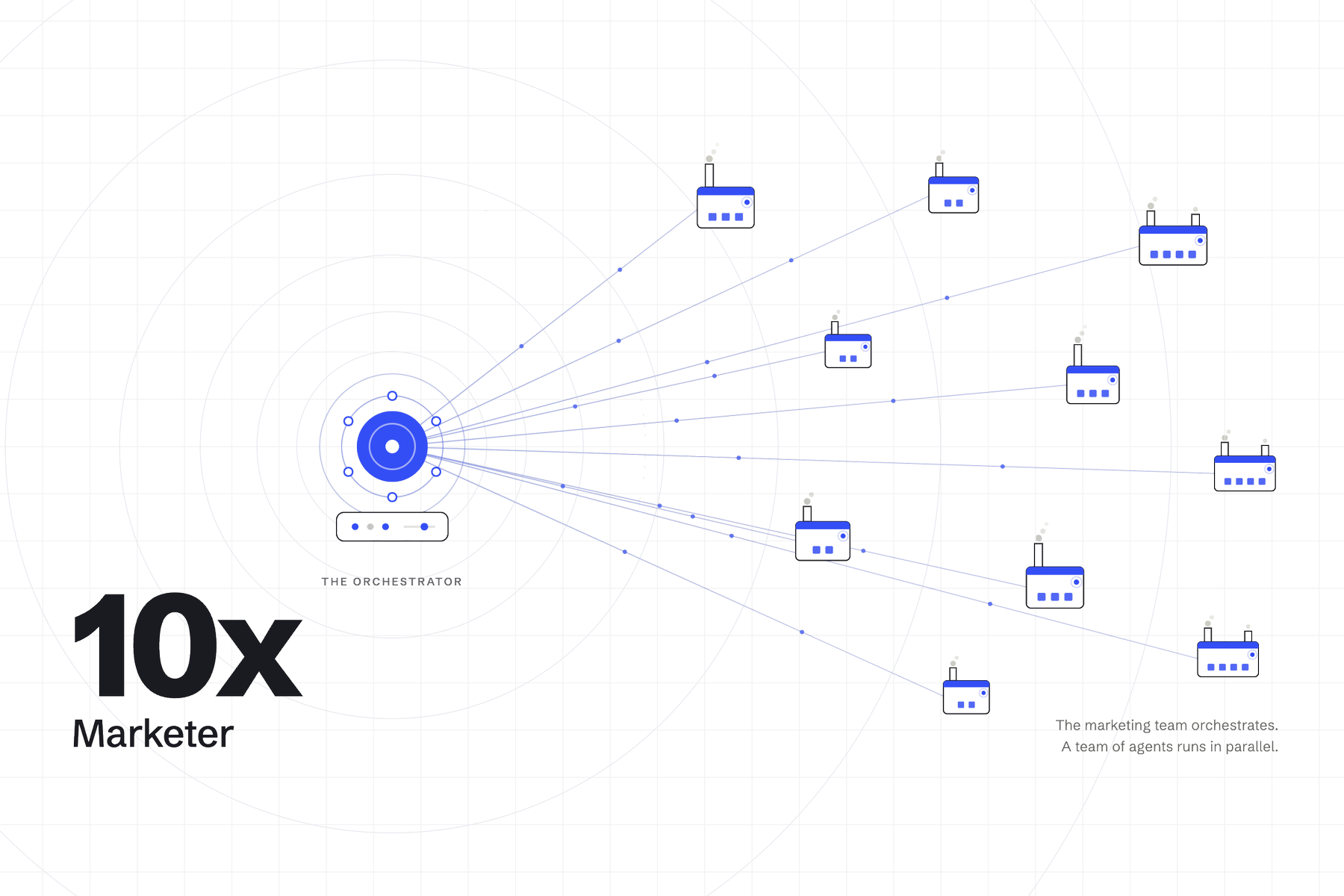
Across every knowledge-intensive industry, agents are taking over the execution layer, the manual, repetitive, coordination-heavy work that used to consume most of a skilled professional's week. Marketing is no exception. When agents handle execution, optimization, and coordination, the marketer's job shifts from managing the assembly line to orchestrating the entire factory.
So what does that do to the stack you’re running today?
Every marketing leader has lived some version of the same story: a new category of tools shows up, promises to fix the chaos, gets adopted everywhere, and within a few years becomes the chaos it was supposed to fix. We are at one of those inflection points again. To understand where things are going, it helps to look at where they have been.
How we got here
The 2000s: the internet gave marketers a channel that scaled. Email, search, and display meant you could reach millions for a fraction of what broadcast used to cost. Salesforce, Adobe, and the other big platforms grew up here, with much of it acquisition-driven.
The 2010s: data and mobile changed the game. Customer Data Platforms, marketing clouds, and behavioral analytics meant you could finally understand who you were talking to, and segment and target more granularly. This is also when the cloud-native data warehouse became transformative. Instead of every tool hoarding its own copy of customer data, companies started centralizing it in one place they actually owned.
The 2020s: composability won. Once data had a permanent home in the warehouse, the rest of the stack could become modular. You no longer needed a single monolithic suite to get a unified view of the customer. You needed a warehouse and a way to sync data in and out of best-of-breed tools. That is the stack most companies run today, and it has a predictable shape.
Today’s marketing stack

Systems of Truth
- Data warehouse / lake: the center of gravity for all customer data (store)
- CDP: where you build segments (segment)
- CMS / DAM: where you store content (organize)
Systems of Activation
- Ad platforms for acquisition
- Marketing automation and customer engagement platforms for lifecycle campaigns
- A/B testing tools for web and app experiments
Where the stack is going
Over the last decade, the marketing stack evolved in two different directions.
The bottom of the stack became the ‘system of truth’. Warehouses and data lakes consolidated enterprise data into a single source of truth.
The top of the stack became the system of execution. ESPs, journey builders, campaign managers, content tools, and analytics products gave marketers places to plan and launch work.
AI changes both layers simultaneously.
In the past year since my last post on how the industry is ripe for consolidation, we've come to three conclusions.
#1) (No surprise) The data stack is consolidating, with everyone racing to own ‘decisioning’
The first wave of AI adoption taught companies two important lessons.
First, AI delivers fundamentally better customer experiences. Systems that continuously predict, recommend, and adapt outperform systems built around static rules and manual segmentation.
Second, AI only works as well as the context available to it. That has accelerated the push toward centralizing enterprise knowledge rather than scattering it across dozens of applications.
This is why infrastructure companies, like Databricks, keep moving upward. The data warehouse and data lake remain gravity central for the organization, and at Auxia, we don’t see that changing anytime soon. But they're also recognizing there is so much more value customers are looking for than simply storing data. They increasingly want to become the platform that understands business context, serves intelligence to applications, and ultimately owns the decision trace, what happened, why it happened, and what should happen next.
The classic CDP is the layer most at risk. A lot of what a CDP does, building audiences, defining segments, giving marketers control over who gets grouped with whom, is fundamentally about marketers exercising control over targeting. But if AI is deciding who gets what, one to one, you probably won’t need a separate audience-building tool when you’re serving a cohort of one. The capabilities of CDPs certainly will not disappear, but it’s likely you probably won’t need a dedicated product completely separate from that.
.png)
#2) Agents are completely disrupting marketing execution
This is where things get much more interesting. The companies at the top of the stack hold a very important position because they own the marketer's relationship and daily workflows. But agentic systems are disrupting this layer too, and the reason is that most of today's systems were built for execution, a manual UI to carry out actions a person already decided on.
They were not built for intelligence. The strategy, decisioning, and optimization that currently take an army of people and an 18-week campaign cycle increasingly look like things that can run continuously and autonomously.
Take a telecom subscription business trying to win back a customer who has gone quiet.
- Rather than a marketer specifying what creative direction they want to take with an email, the system proposes it proactively. It notices the lapse in engagement and surfaces a win-back campaign on its own, before anyone puts it on the roadmap.
- Rather than defining an audience to target, a model predicts the right content for that specific user at the moment it matters. Instead of slotting her into a generic "at-risk" segment, it decides in real time that she responds better to a product update than a discount, because that is what has worked for her before.
- Rather than spinning up one more win-back sequence to supplement the fifteen already running that nobody can fully audit, the marketer sets goals and guardrails (e.g. protect margin, stay on brand, do not over-message), and lets the system operate inside them, surfacing what worked and what did not without anyone digging for it.
#3) To drive transformative change for your company, you need to adapt both capabilities
Replacing one layer independently is probably not going to cut it.
The companies with the richest business context, best decision making in the world, and incredible model performance will struggle to drive adoption if they aren’t tailor-made for marketers.
The companies with beautiful marketer experiences but no understanding of enterprise context struggle to produce differentiated outcomes.
Over the long term, we expect both of these layers to continue converging. What’s important for you to remember though is that as agents take overt more and more of the manual work, the underlying execution matters less and less. What product you’re using to send an email becomes less important as long as your team can build it 10x faster, reach people 10x more precisely, and deliver 10x higher quality experiences.
This is really the value that agents bring to the table.
What does this mean for my company?
To drive truly transformative change in your organization around marketing and customer engagement, you’ll need three capabilities:
First, you need an omnipresent "brain" across the organization, something that connects to all of your existing context and data rather than sitting next to it as one more disconnected tool. It has to read campaign history, brand guidelines, audience behavior, and past performance well enough to know the business from day one, and get smarter with every campaign that runs.
Second, you need a way to curate the experience for every single user individually. The closest analogy is giving every customer their own marketing agency and their own data scientist. Not a segment they get bucketed into, but a one-to-one read on who they are and what they need.
Lastly, you need a suite of tools that actually takes the operational burden off your teams, because executing on all of it is usually half the battle. Knowing the right move means little if your team still has to manually build, launch, and audit it.
In our view, there’s a few ways you can tackle this:
- Bet on a legacy platform
Most incumbents recognize where the market is headed and are investing in building a lot of these capabilities themselves. The trade off here is that you risk broader organizational transformation by working with companies that are rebuilding decade old platforms with agents that have to remain backward compatible with legacy tech.
- Build all of it, or components, yourself
A lot of companies choose to build their own stack for maximum flexibility and control. If you have the resources and engineering talent, it’s a great option. But companies today don’t have the luxury of waiting a whole year to build it and take their best engineers away to maintain and update it when their board is demanding impact next quarter.
- Partner with an AI-native brand
If you go with a company that has designed their architecture around ML and Agents from the beginning, you can connect to every component of your stack right away and deliver value immediately as your organization evolves. As the capabilities mature, companies can replace legacy execution tools over time, or swap them for lower-cost alternatives, without rebuilding the intelligence layer that sits across them.